E-commerce store on Next.js 16 (App Router), MySQL 8 and Supabase Auth
E-commerce storefront: product catalog with per-SKU variants, guest-compatible carts, and price-snapshotting orders.
54 files, 3 tables and 173 lines of schema, verified 2026-08-23 on Next.js 16 (App Router), MySQL 8 and Supabase Auth.
16 pinned upstream versions
request path. session validation runs in server components and route handlers, not at the edge
What you're getting
Next.js 16 App Router: file-based routing, server components, and the Edge proxy (Next 16's renamed middleware).
MySQL 8 via Drizzle ORM and the mysql2 driver.
Supabase Auth: hosted identity (GoTrue) via the @supabase/ssr cookie client; email+password + OAuth.
E-commerce storefront: product catalog with per-SKU variants, guest-compatible carts, and price-snapshotting orders.
Setup
bun add next react react-dom drizzle-orm mysql2 @supabase/ssr @supabase/supabase-jsDATABASE_URLMySQL connection string (mysql://…)NEXT_PUBLIC_SUPABASE_URLNext: your Supabase project URL (RR: VITE_SUPABASE_URL · Nuxt: NUXT_PUBLIC_SUPABASE_URL)NEXT_PUBLIC_SUPABASE_ANON_KEYNext: the project's anon/public key (RR: VITE_SUPABASE_ANON_KEY · Nuxt: NUXT_PUBLIC_SUPABASE_ANON_KEY)SUPABASE_URLReact Router server-side (loaders): same project URL, read off process.env — never inlined into the client bundleSUPABASE_ANON_KEYReact Router server-side: same anon keyApply the schema with bunx drizzle-kit push
Initialization
Database client
E-commerce schema: product catalog, carts & orders
6 tables, 31 columns and 16 indexes and constraints, applied to a live MySQL 8 and asserted to materialize.
products5 columns · 3 indexedproduct_variants7 columns · 3 indexedcarts3 columns · 2 indexedcart_items4 columns · 3 indexedorders6 columns · 3 indexedorder_items6 columns · 2 indexedWhat this schema is built to answer
products.slug is unique and carries idx_product_slug for the lookup; idx_variant_product on product_variants.product_id then returns every buyable SKU with its price_cents and inventory_qty in one scan.
The composite unique cart_items_cart_variant_unique on (cart_id, variant_id) is the conflict target: re-adding a SKU bumps quantity on the row that already exists rather than leaving two lines for one variant.
carts.user_id is nullable and indexed by idx_cart_user, and cart_items references cart_id rather than the shopper — so claiming a guest cart is one UPDATE against a single carts row, with the items following for free.
orders.status is text under orders_status_check with idx_order_status over it, so the warehouse view is an index scan and adding a 'refunded' state is a constraint change instead of an ALTER TYPE.
idx_order_item_order on order_items.order_id returns the lines, each holding its own frozen sku and unit_price_cents; variant_id is ON DELETE SET NULL, so retiring a SKU cannot rewrite the receipt.
Product catalog & variantsproducts (display unit) and product_variants (buyable SKUs carrying price_cents and inventory_qty)
Cart & checkoutcarts (nullable user_id for guest shoppers) and cart_items (one row per variant per cart, quantity-bumped on re-add)
Orders & line itemsorders (captured totalCents + status walk) and order_items (frozen sku + unitPriceCents snapshot, variantId set-null on delete)
Deploy targets
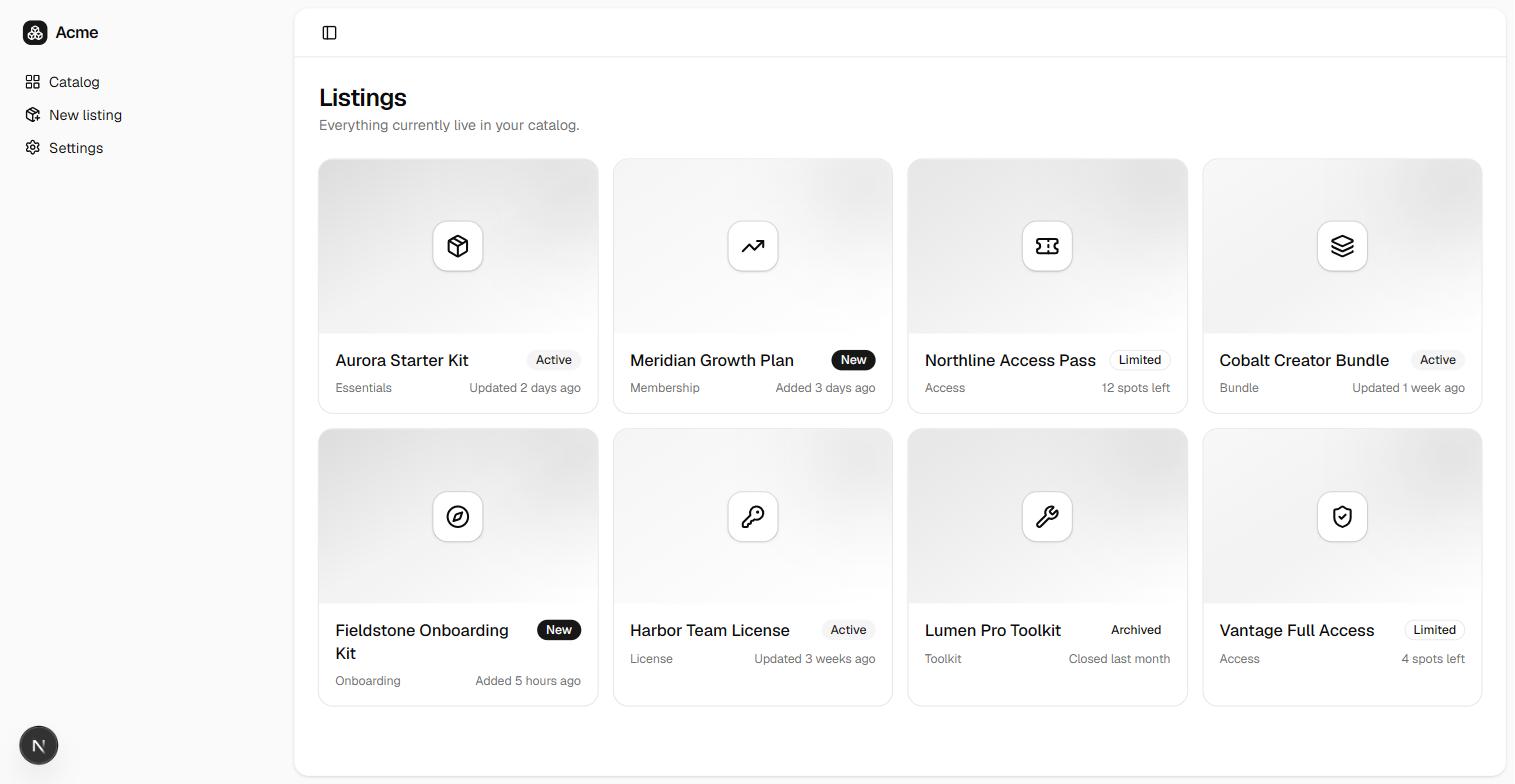
The app UI
Decisions and compatibility
Auth runs in proxy.ts (Next 16's renamed middleware) on the Edge runtime: it gates on the session cookie's presence only — full session validation happens in Server Components and route handlers, not in the proxy.
mysql2's pool multiplexes connections; drizzle-orm/mysql2 wraps it. One module-level pool is right for a serverless/edge app — the runtime and the pool handle concurrency.
MySQL has no row-level security: multi-tenant isolation is enforced in application code via the forOrg helper (src/lib/tenant.ts), not by the database. See the tenant-scoping section on SaaS pages.
Hosted: Supabase owns identity in its managed auth.users. This stack emits a LOCAL `user` mirror (db/auth-schema.ts) so app-type schemas can foreign-key `user` directly — keep it in sync with a Supabase trigger on auth.users (insert/update → public.user). The drizzle migration only owns the mirror table's shape, not the trigger.
Sessions are cookie-based (@supabase/ssr): the proxy refreshes them on every request; Server Components read the user via supabase.auth.getUser().
Money is stored as integer cents on product_variants (price_cents) and snapshotted onto order_items (unit_price_cents) at checkout — repricing or deleting a variant never rewrites order history.
cart_items carries a composite unique on (cart_id, variant_id) so the app bumps quantity rather than inserting duplicate rows; orders.status is a text + CHECK column (pending/paid/shipped/cancelled) to avoid ALTER TYPE migrations.
MySQL provides no row-level security. On MySQL, multi-tenant isolation is APP-ENFORCED via the forOrg helper (src/lib/tenant.ts), not database-enforced like Postgres RLS. Every org-scoped query MUST go through forOrg — a missed query leaks across tenants. Postgres cells enforce this in the database itself (RLS), so it holds even for a query that forgets to scope.
How this stack fits together
Supabase Auth owns its identity tables in the same database as products, product_variants, carts, cart_items, orders and order_items, so the foreign keys reference the local user row directly and a delete cascades through them. No mirror, no webhook, and no window where the two stores disagree.
MySQL 8 stores those surrogate keys as varchar(36), so every foreign key across the 6 tables and 31 columns below is a varchar(36) column. The migration was applied to a live MySQL 8 and the tables asserted, not just type-checked.
E-commerce store
Price and stock do not live on a product here. products holds the display unit — a unique slug (indexed as idx_product_slug), a name, a description — while product_variants holds what a shopper can actually buy: a unique sku, price_cents, inventory_qty, one row per SKU under its product. Everything downstream points at a variant rather than a product, which is why 'Large / Black is sold out but Medium is not' is representable without a nullable stock column or a JSON blob. Carts are two tables and one constraint.
carts.user_id is text (matching Better Auth's user.id) and nullable, so a guest can fill a basket before an account exists to attach it to; claiming that basket at login is a single UPDATE on carts, because cart_items hangs off cart_id and not off the shopper. cart_items then carries the composite unique (cart_id, variant_id), which turns 'add to cart' into an upsert that bumps quantity instead of an insert that quietly leaves the same SKU on two checkout lines. Orders exist in order to stop being the catalog. order_items does not read price through its variant FK: it stores sku and unit_price_cents copied at checkout, and variant_id is nullable with ON DELETE SET NULL.
Reprice a variant, rename a SKU, discontinue a line — last quarter's orders still total what the customer was charged, and the FK is a convenience for 'show me this product's sales' rather than the source of the money. orders.total_cents is the captured total; provider_payment_id is an opaque Stripe-or-whoever string, deliberately not a foreign key into a payments table this schema does not own; orders.user_id is ON DELETE SET NULL so a closed account does not erase its own sales history. All money is integer cents, never numeric or float, and orders.status is text under orders_status_check (pending, paid, shipped, cancelled) with idx_order_status behind it.
What the schema does not do is reserve inventory: inventory_qty is a plain column with no hold, no reservation table and nothing stopping it going negative, so overselling under concurrency is your checkout transaction's problem.
Next.js 16 (App Router)
Next 16's App Router keeps the whole application under src/: the scaffold runs create-next-app with --src-dir and --import-alias @/*, so `@/` resolves to src/* and the verified files land on top of a stock project rather than replacing it. initCode writes the database client to src/lib/db.ts, then appends the auth fragment's own files — identity tables at src/db/auth-schema.ts, the auth instance at src/lib/auth.ts, a catch-all handler under src/app/api/auth/, and src/proxy.ts. Each file has exactly one owner; the framework never re-emits the ones auth brought. Server code has two shapes here and they are not interchangeable. A Server Component runs on the server and imports { db } from "@/lib/db" directly, so a page can await a Drizzle query with no API route in between.
Anything that needs a URL — an OAuth callback, a Polar or Clerk webhook, a mutation posted from the client — is a route handler at src/app/api/<path>/route.ts exporting GET or POST. Session checking is split across two tiers on purpose. src/proxy.ts (Next 16's rename of middleware.ts; under --src-dir it must sit beside src/app or Next silently ignores it) runs on the Edge runtime with a config.matcher listing the guarded prefixes — /dashboard/:path* and /settings/:path* out of the box. It only asks whether a session cookie exists and redirects to /sign-in when it does not: no database round trip at the edge. The authoritative check is auth.api.getSession() inside the Server Component or route handler that actually reads rows.
What that means when you build on it: widening the protected surface is a one-line change to the matcher array, but the proxy is not the security boundary — a request carrying any session cookie reaches the page, and the page decides. Keep the real check next to the data. The UI overlay follows the same split, with auth screens under src/app/(auth)/ and the shell and dashboard under src/app/(app)/.
MySQL 8
MySQL 8 here is the mysql2 driver under Drizzle's mysql-core dialect: drizzle({ client: pool }) over one module-level mysql.createPool(DATABASE_URL). mysql2's pool multiplexes connections itself, so a single pool per module is the right shape — the runtime and the pool handle concurrency, with no globalThis singleton needed. The framework decides where that file lands (src/lib/db.ts on Next, app/lib/db.ts on React Router, server/lib/db.ts on Nuxt); the client text is the same in all three. The dialect's constraints show up directly in the column types.
MySQL cannot index a TEXT column without a prefix length, so anything that is a primary key, a UNIQUE, an index or a CHECK target is varchar with a declared length: ids are varchar(36) with no database default — the application generates them with crypto.randomUUID(), since there is no uuid type and no defaultRandom() — Better Auth's user.id and every FK pointing at it are varchar(255), an email or slug is varchar(255), a role or status varchar(32), a SHA-256 hex digest varchar(64). Free-form columns nobody indexes stay text. Timestamps are plain timestamp().defaultNow() without the withTimezone flag the Postgres bodies carry, and counters are bigint({ mode: "number" }). The operational difference that matters most: MySQL has no row-level security.
There is no policy layer to fall back on, so multi-tenant isolation is enforced in application code by forOrg(db, orgId) in src/lib/tenant.ts, which wraps each org-owned table's select/update/delete with a where on organization_id and throws on a missing orgId instead of quietly running unscoped. It is a real boundary only while every read and write goes through it — the shared plans catalog sits deliberately outside — and it is app-enforced, not database-enforced. Connections change with the deploy target: connectionLimit 2 per short-lived serverless instance, 10 in a long-running Node process, and on Cloudflare Workers mysql2 cannot run at all — there are no TCP sockets — so the edge client swaps to @planetscale/database over HTTP with drizzle-orm/planetscale-serverless.
Supabase Auth
Supabase Auth is a hosted service — GoTrue — that your app reaches over cookies rather than an SDK session object. Credentials and the canonical user records live in Supabase's managed auth.users schema. What lands in your own database is a mirror: db/auth-schema.ts declares user keyed by the Supabase auth uid (text; varchar(255) on MySQL) with email, full name, avatar URL and timestamps, so app-type schemas can foreign-key user exactly as they would under a self-hosted auth. Unlike the Clerk fragment, no sync webhook is emitted here, because Supabase's own trigger mechanism is the intended path: a trigger on auth.users writing into public.user lives in the Supabase project, not in the drizzle migration.
The migration owns the mirror's column shape and nothing else, so wiring that trigger is a step you take before those foreign keys mean anything. The mechanic that actually shapes this adapter is cookie refresh. @supabase/ssr rotates the auth token, and a rotated cookie only reaches the browser if something writes it onto the outgoing response — which is why every framework branch is built around the same getAll/setAll pair, wired to whatever that framework calls a cookie jar. Next's src/proxy.ts rebuilds the NextResponse inside setAll before calling getUser().
React Router has no middleware layer, so app/lib/supabase/server.ts constructs the client per request and returns { supabase, headers }, and the protected layout route attaches those headers to both exits — the redirect and the pass-through — so a refresh that happened during a guard is not lost. Nuxt's server/utils/supabase.ts binds the client to the h3 event and writes through setCookie, with a Nitro middleware doing the guard. Every decision point calls supabase.auth.getUser(), never getSession(): getSession reads whatever the cookie claims, getUser revalidates it against Supabase. Because a browser client is emitted alongside the server one, the auth screens are real forms calling supabase.auth.signInWithPassword rather than a hosted widget, and the sidebar's user menu subscribes to onAuthStateChange. Two consequences to plan around.
The anon key is public by design and is inlined into the client bundle under whichever prefix the framework demands (NEXT_PUBLIC_, VITE_, NUXT_PUBLIC_), so protection has to come from row-level security on Supabase's side, not from keeping the key quiet. And every guard is a network call to Supabase, not a local query — cheap, but not free, and on the path of every protected request.