AI Wrapper on Nuxt 4, MySQL 8 and Supabase Auth
Type-checked against the real SDKs, migration applied to a live MySQL 8, connection clients load-tested, then tracked for upstream drift and re-verified when it moves. How we verify
session validation runs in server components and route handlers, not at the edge
What you're getting
Nuxt 4 (framework mode) — full-stack Vue SSR: client under app/ (Vite), server under server/ (Nitro), API as server/api/*.post.ts Nitro route handlers.
MySQL 8 via Drizzle ORM and the mysql2 driver.
Supabase Auth — hosted identity (GoTrue) via the @supabase/ssr cookie client; email+password + OAuth.
AI-wrapper app — per-user profile extending Better Auth, per-call token metering, and append-only prompt/completion history.
Setup
bun add nuxt vue drizzle-orm mysql2 @supabase/ssr @supabase/supabase-jsDATABASE_URLMySQL connection string (mysql://…)NEXT_PUBLIC_SUPABASE_URLNext: your Supabase project URL (RR: VITE_SUPABASE_URL · Nuxt: NUXT_PUBLIC_SUPABASE_URL)NEXT_PUBLIC_SUPABASE_ANON_KEYNext: the project's anon/public key (RR: VITE_SUPABASE_ANON_KEY · Nuxt: NUXT_PUBLIC_SUPABASE_ANON_KEY)SUPABASE_URLReact Router server-side (loaders): same project URL, read off process.env — never inlined into the client bundleSUPABASE_ANON_KEYReact Router server-side: same anon keyApply the schema with bunx drizzle-kit push
Initialization
Database client
import { drizzle } from "drizzle-orm/mysql2";
import mysql from "mysql2/promise";
// ponytail: single module-level pool; the runtime + mysql2's pool handle concurrency,
// so no globalThis singleton dance needed.
const pool = mysql.createPool(process.env.DATABASE_URL!);
export const db = drizzle({ client: pool });// Supabase needs NO Nuxt module (unlike Clerk) — but it DOES need its keys declared as public
// runtimeConfig. `process.env.NUXT_PUBLIC_*` is readable server-side only; the browser bundle can
// reach these values through runtimeConfig.public and nothing else. Nuxt's env convention fills
// both from the same vars (NUXT_PUBLIC_SUPABASE_URL → runtimeConfig.public.supabaseUrl), so the
// server client below and the browser client (~~/lib/supabase-client) resolve to identical keys.
// ponytail: Nuxt provides defineNuxtConfig as a global at runtime; import it explicitly from
// "nuxt/config" so this config type-checks under standalone tsc.
import { defineNuxtConfig } from "nuxt/config";
export default defineNuxtConfig({
runtimeConfig: {
public: {
supabaseUrl: "", // ← NUXT_PUBLIC_SUPABASE_URL
supabaseAnonKey: "", // ← NUXT_PUBLIC_SUPABASE_ANON_KEY
},
},
});import { mysqlTable, timestamp, varchar } from "drizzle-orm/mysql-core";
// Local mirror of Supabase identity — synced from auth.users by a Supabase trigger (see notes).
// id = the Supabase auth uid (text); the app-type user_id FKs resolve against it.
export const user = mysqlTable("user", {
id: varchar("id", { length: 255 }).primaryKey(), // = Supabase auth.users.id
email: varchar("email", { length: 255 }),
fullName: varchar("full_name", { length: 255 }),
avatarUrl: varchar("avatar_url", { length: 1024 }),
updatedAt: timestamp("updated_at"),
createdAt: timestamp("created_at").notNull().defaultNow(),
});// Per-request Supabase client for Nitro (Nuxt 4). h3 carries the cookie jar on the
// event, so this is the same @supabase/ssr client as every other framework with h3 plumbing.
// ponytail: Nuxt AUTO-IMPORTS server/utils/* and the h3 helpers at runtime; both are imported
// EXPLICITLY here so the file also type-checks under standalone tsc (spec §6).
// Reads the NUXT_PUBLIC_* vars directly (server-side they are plain env) — the SAME vars Nuxt maps
// into runtimeConfig.public for the browser client, so both halves agree on one source of truth.
import { createServerClient } from "@supabase/ssr";
import { parseCookies, setCookie, type H3Event } from "h3";
export function serverSupabase(event: H3Event) {
return createServerClient(
process.env.NUXT_PUBLIC_SUPABASE_URL!,
process.env.NUXT_PUBLIC_SUPABASE_ANON_KEY!,
{
cookies: {
getAll() {
return Object.entries(parseCookies(event)).map(([name, value]) => ({ name, value }));
},
setAll(cookiesToSet) {
cookiesToSet.forEach(({ name, value, options }) => setCookie(event, name, value, options));
},
},
},
);
}// Session guard as a Nitro server middleware — the Nuxt analog of Next's proxy.ts. Runs on every
// request: getUser() revalidates the token server-side (never trust getSession() here) and any
// refreshed cookies are written straight onto the event by serverSupabase's setAll.
import { defineEventHandler, getRequestURL, sendRedirect } from "h3";
import { serverSupabase } from "../utils/supabase";
// ponytail: guard the SaaS app surface; widen the prefixes per app-type.
const PROTECTED_PREFIXES = ["/dashboard", "/settings"];
export default defineEventHandler(async (event) => {
const { pathname } = getRequestURL(event);
if (!PROTECTED_PREFIXES.some((prefix) => pathname.startsWith(prefix))) return;
const {
data: { user },
} = await serverSupabase(event).auth.getUser();
if (!user) return sendRedirect(event, "/sign-in", 302);
});AI app schema: user profiles, token metering & prompt logs
User profiles extending Better Authone profile per Better Auth user, carrying default model preference and soft monthly token budget
Per-call token usage & cost meteringappend-only rows (one per upstream LLM call) that drive the per-user budget rollup and cost reporting
Prompt & completion log historyauditable record of every exchange — prompt, completion, token split, latency, and ok/error/filtered status
// === file: server/db/schema.ts ===
import { relations, sql } from "drizzle-orm";
import {
bigint,
check,
index,
int,
json,
mysqlTable,
text,
timestamp,
varchar,
} from "drizzle-orm/mysql-core";
// Better Auth owns identity; we only reference its `user` table by id.
import { user } from "./auth-schema";
export type CallStatus = "ok" | "error" | "filtered";
/** One profile per Better Auth user — extends identity with AI-app preferences
* and the soft monthly token budget the metering layer enforces. */
export const userProfiles = mysqlTable(
"user_profiles",
{
id: varchar("id", { length: 36 }).primaryKey(),
// Better Auth's user.id is text — match it as varchar(255). One profile per
// user, so the FK itself is unique (this is the 1:1 extension of `user`).
userId: varchar("user_id", { length: 255 })
.notNull()
.unique()
.references(() => user.id, { onDelete: "cascade" }),
displayName: text("display_name"),
// Default model this user's requests fall back to (e.g. gpt-4o-mini).
defaultModel: varchar("default_model", { length: 255 }).notNull().default("gpt-4o-mini"),
// Soft cap the metering layer checks token_usage against per calendar month.
monthlyTokenBudget: bigint("monthly_token_budget", { mode: "number" })
.notNull()
.default(0),
createdAt: timestamp("created_at").notNull().defaultNow(),
},
(t) => [index("idx_profile_model").on(t.defaultModel)],
);
/** Append-only token meter: one row per upstream LLM call. Roll up by
* user + window for budget enforcement and cost reporting. */
export const tokenUsage = mysqlTable(
"token_usage",
{
id: varchar("id", { length: 36 }).primaryKey(),
userId: varchar("user_id", { length: 255 })
.notNull()
.references(() => user.id, { onDelete: "cascade" }),
// Which upstream model was billed (provider model id, opaque to us).
model: varchar("model", { length: 255 }).notNull(),
promptTokens: int("prompt_tokens").notNull().default(0),
completionTokens: int("completion_tokens").notNull().default(0),
// ponytail: store cost in micro-cents as an integer — no float money, and
// fine-grained enough for sub-cent per-token pricing without a numeric type.
costMicrocents: bigint("cost_microcents", { mode: "number" })
.notNull()
.default(0),
createdAt: timestamp("created_at").notNull().defaultNow(),
},
(t) => [
// Drives the "tokens used this month" rollup + budget check.
index("idx_usage_user_time").on(t.userId, t.createdAt),
index("idx_usage_model").on(t.model),
],
);
/** Append-only prompt/completion history — the auditable record of every
* exchange (prompt in, completion out, model, token split, outcome). */
export const promptLogs = mysqlTable(
"prompt_logs",
{
id: varchar("id", { length: 36 }).primaryKey(),
userId: varchar("user_id", { length: 255 })
.notNull()
.references(() => user.id, { onDelete: "cascade" }),
model: varchar("model", { length: 255 }).notNull(),
prompt: text("prompt").notNull(),
// Null while a streamed completion is still in flight.
completion: text("completion"),
promptTokens: int("prompt_tokens").notNull().default(0),
completionTokens: int("completion_tokens").notNull().default(0),
latencyMs: int("latency_ms"),
status: varchar("status", { length: 32 }).$type<CallStatus>().notNull().default("ok"),
// ponytail: opaque per-call metadata (tool calls, finish_reason, etc.) —
// json bag beats a column-per-provider-field churn.
metadata: json("metadata"),
createdAt: timestamp("created_at").notNull().defaultNow(),
},
(t) => [
// Drives the per-user history feed (most-recent-first).
index("idx_log_user_time").on(t.userId, t.createdAt),
check(
"prompt_logs_status_check",
sql`${t.status} in ('ok','error','filtered')`,
),
],
);
export const userProfilesRelations = relations(userProfiles, ({ one }) => ({
user: one(user, {
fields: [userProfiles.userId],
references: [user.id],
}),
}));
export const tokenUsageRelations = relations(tokenUsage, ({ one }) => ({
user: one(user, { fields: [tokenUsage.userId], references: [user.id] }),
}));
export const promptLogsRelations = relations(promptLogs, ({ one }) => ({
user: one(user, { fields: [promptLogs.userId], references: [user.id] }),
}));
Deploy targets
import { drizzle } from "drizzle-orm/mysql2";
import mysql from "mysql2/promise";
// Serverless: a small pool per short-lived instance — many instances × a big pool exhausts MySQL.
export const pool = mysql.createPool({ uri: process.env.DATABASE_URL!, connectionLimit: 2 });
export const db = drizzle({ client: pool });
import { drizzle } from "drizzle-orm/mysql2";
import mysql from "mysql2/promise";
// Long-running process: a real, reused pool (mysql2 manages idle recycling).
export const pool = mysql.createPool({ uri: process.env.DATABASE_URL!, connectionLimit: 10 });
export const db = drizzle({ client: pool });
import { drizzle } from "drizzle-orm/planetscale-serverless";
import { Client } from "@planetscale/database";
// Edge/Workers have NO TCP sockets, so mysql2 cannot run here. PlanetScale's HTTP driver
// speaks MySQL over fetch — the client that works on Workers (the MySQL analog of Neon's HTTP driver).
const client = new Client({ url: process.env.DATABASE_URL! });
export const db = drizzle({ client });
The app UI

<script setup lang="ts">
import { computed, onBeforeUnmount, onMounted, ref } from "vue"
import {
EllipsisVerticalIcon,
CircleUserRoundIcon,
CreditCardIcon,
BellIcon,
LogOutIcon,
} from "lucide-vue-next"
import type { User } from "@supabase/supabase-js"
import { Avatar, AvatarFallback, AvatarImage } from "@/components/ui/avatar"
import {
DropdownMenu,
DropdownMenuContent,
DropdownMenuGroup,
DropdownMenuItem,
DropdownMenuLabel,
DropdownMenuSeparator,
DropdownMenuTrigger,
} from "@/components/ui/dropdown-menu"
import { SidebarMenu, SidebarMenuButton, SidebarMenuItem, useSidebar } from "@/components/ui/sidebar"
import { Skeleton } from "@/components/ui/skeleton"
import { createClient } from "~~/lib/supabase-client"
// Supabase variant of the sidebar-footer user menu — the SAME shell every auth overlay reuses, wired
// to the browser Supabase client: getUser() on mount + onAuthStateChange to stay reactive across tabs,
// cookie-based sign-out.
const { isMobile } = useSidebar()
const supabase = createClient()
const user = ref<User | null>(null)
const loading = ref(true)
let unsubscribe: (() => void) | undefined
onMounted(async () => {
const { data } = await supabase.auth.getUser()
user.value = data.user
loading.value = false
const { data: listener } = supabase.auth.onAuthStateChange((_event, session) => {
user.value = session?.user ?? null
})
unsubscribe = () => listener.subscription.unsubscribe()
})
onBeforeUnmount(() => unsubscribe?.())
const email = computed(() => user.value?.email ?? "")
const initials = computed(() => email.value.slice(0, 2).toUpperCase())
const avatarUrl = computed(() => {
const url = user.value?.user_metadata?.avatar_url
return typeof url === "string" ? url : undefined
})
async function handleSignOut() {
await supabase.auth.signOut()
navigateTo("/sign-in")
}
</script>
<template>
<SidebarMenu>
<SidebarMenuItem>
<div v-if="loading" class="flex items-center gap-2 p-2">
<Skeleton class="size-8 rounded-lg" />
<Skeleton class="h-4 w-28 rounded-md" />
</div>
<DropdownMenu v-else-if="user">
<DropdownMenuTrigger as-child>
<SidebarMenuButton
size="lg"
class="data-[state=open]:bg-sidebar-accent data-[state=open]:text-sidebar-accent-foreground"
>
<Avatar class="size-8 rounded-lg grayscale">
<AvatarImage v-if="avatarUrl" :src="avatarUrl" :alt="email" />
<AvatarFallback class="rounded-lg">{{ initials }}</AvatarFallback>
</Avatar>
<div class="grid flex-1 text-left text-sm leading-tight">
<span class="truncate font-medium">{{ email }}</span>
</div>
<EllipsisVerticalIcon class="ml-auto size-4" />
</SidebarMenuButton>
</DropdownMenuTrigger>
<DropdownMenuContent
class="min-w-56 rounded-lg"
:side="isMobile ? 'bottom' : 'right'"
align="end"
:side-offset="4"
>
<DropdownMenuLabel class="p-0 font-normal">
<div class="flex items-center gap-2 px-1 py-1.5 text-left text-sm">
<Avatar class="size-8 rounded-lg">
<AvatarImage v-if="avatarUrl" :src="avatarUrl" :alt="email" />
<AvatarFallback class="rounded-lg">{{ initials }}</AvatarFallback>
</Avatar>
<div class="grid flex-1 text-left text-sm leading-tight">
<span class="truncate font-medium">{{ email }}</span>
</div>
</div>
</DropdownMenuLabel>
<DropdownMenuSeparator />
<DropdownMenuGroup>
<DropdownMenuItem>
<CircleUserRoundIcon />
Account
</DropdownMenuItem>
<DropdownMenuItem>
<CreditCardIcon />
Billing
</DropdownMenuItem>
<DropdownMenuItem>
<BellIcon />
Notifications
</DropdownMenuItem>
</DropdownMenuGroup>
<DropdownMenuSeparator />
<DropdownMenuItem @click="handleSignOut">
<LogOutIcon />
Log out
</DropdownMenuItem>
</DropdownMenuContent>
</DropdownMenu>
</SidebarMenuItem>
</SidebarMenu>
</template><script setup lang="ts">
import AppSidebar from "@/components/app-sidebar.vue"
import SiteHeader from "@/components/site-header.vue"
import { SidebarInset, SidebarProvider } from "@/components/ui/sidebar"
// Authed app shell (Supabase overlay). SidebarProvider owns the collapse state; AppSidebar +
// SiteHeader frame the routed page (<slot />). The auth gate lives in the route middleware (client) +
// the Nitro server middleware (SSR/API, session refresh) — the layout just composes the chrome.
</script>
<template>
<SidebarProvider>
<AppSidebar />
<SidebarInset>
<SiteHeader />
<div class="flex flex-1 flex-col gap-4">
<slot />
</div>
</SidebarInset>
</SidebarProvider>
</template>import { createClient } from "~~/lib/supabase-client"
// Client-side route guard for the app surface. The Nitro server middleware (init) is the true
// security boundary on SSR/API; this bounces client-side SPA navigation for logged-out users before
// the protected page renders. Pages opt in via definePageMeta({ middleware: "auth" }).
export default defineNuxtRouteMiddleware(async () => {
const supabase = createClient()
const { data } = await supabase.auth.getSession()
if (!data.session) {
return navigateTo("/sign-in")
}
})<script setup lang="ts">
import { ref } from "vue"
import Logo from "@/components/logo.vue"
import { Button } from "@/components/ui/button"
import { Card, CardContent, CardDescription, CardHeader, CardTitle } from "@/components/ui/card"
import { Input } from "@/components/ui/input"
import { Label } from "@/components/ui/label"
import { createClient } from "~~/lib/supabase-client"
// Supabase email+password sign-in. Supabase supports it natively (unlike Clerk's hosted widget), so
// this is a real form calling supabase.auth.signInWithPassword. `layout: false` opts out of the
// dashboard shell.
definePageMeta({ layout: false })
const supabase = createClient()
const email = ref("")
const password = ref("")
const error = ref("")
const loading = ref(false)
async function onSubmit() {
loading.value = true
error.value = ""
const { error: err } = await supabase.auth.signInWithPassword({ email: email.value, password: password.value })
loading.value = false
if (err) {
error.value = err.message
return
}
navigateTo("/dashboard")
}
</script>
<template>
<div class="flex min-h-svh items-center justify-center p-4">
<Card class="w-full max-w-sm">
<CardHeader>
<Logo class="mb-2" />
<CardTitle>Welcome back</CardTitle>
<CardDescription>Sign in to your account to continue.</CardDescription>
</CardHeader>
<CardContent>
<form class="flex flex-col gap-4" @submit.prevent="onSubmit">
<div class="flex flex-col gap-2">
<Label for="email">Email</Label>
<Input id="email" v-model="email" type="email" placeholder="you@example.com" required />
</div>
<div class="flex flex-col gap-2">
<Label for="password">Password</Label>
<Input id="password" v-model="password" type="password" required />
</div>
<p v-if="error" class="text-destructive text-sm">{{ error }}</p>
<Button type="submit" :disabled="loading" class="w-full">
{{ loading ? "Signing in…" : "Sign in" }}
</Button>
<p class="text-muted-foreground text-center text-sm">
No account?
<NuxtLink to="/sign-up" class="text-foreground underline underline-offset-4">Sign up</NuxtLink>
</p>
</form>
</CardContent>
</Card>
</div>
</template><script setup lang="ts">
import { ref } from "vue"
import Logo from "@/components/logo.vue"
import { Button } from "@/components/ui/button"
import { Card, CardContent, CardDescription, CardHeader, CardTitle } from "@/components/ui/card"
import { Input } from "@/components/ui/input"
import { Label } from "@/components/ui/label"
import { createClient } from "~~/lib/supabase-client"
// Supabase email+password sign-up. On success the user may need to confirm their email (a project
// setting): with confirmation off Supabase returns a session and we go straight to /dashboard;
// with it on there's no session yet, so we show a "check your email" state instead.
definePageMeta({ layout: false })
const supabase = createClient()
const email = ref("")
const password = ref("")
const error = ref("")
const loading = ref(false)
const done = ref(false)
async function onSubmit() {
loading.value = true
error.value = ""
const { data, error: err } = await supabase.auth.signUp({ email: email.value, password: password.value })
loading.value = false
if (err) {
error.value = err.message
return
}
if (data.session) {
navigateTo("/dashboard")
return
}
done.value = true
}
</script>
<template>
<div class="flex min-h-svh items-center justify-center p-4">
<Card v-if="done" class="w-full max-w-sm">
<CardHeader>
<Logo class="mb-2" />
<CardTitle>Check your email</CardTitle>
<CardDescription>We sent a confirmation link. Click it to finish creating your account.</CardDescription>
</CardHeader>
</Card>
<Card v-else class="w-full max-w-sm">
<CardHeader>
<Logo class="mb-2" />
<CardTitle>Create your account</CardTitle>
<CardDescription>Start your workspace in seconds.</CardDescription>
</CardHeader>
<CardContent>
<form class="flex flex-col gap-4" @submit.prevent="onSubmit">
<div class="flex flex-col gap-2">
<Label for="email">Email</Label>
<Input id="email" v-model="email" type="email" placeholder="you@example.com" required />
</div>
<div class="flex flex-col gap-2">
<Label for="password">Password</Label>
<Input id="password" v-model="password" type="password" required />
</div>
<p v-if="error" class="text-destructive text-sm">{{ error }}</p>
<Button type="submit" :disabled="loading" class="w-full">
{{ loading ? "Creating account…" : "Sign up" }}
</Button>
<p class="text-muted-foreground text-center text-sm">
Already have an account?
<NuxtLink to="/sign-in" class="text-foreground underline underline-offset-4">Sign in</NuxtLink>
</p>
</form>
</CardContent>
</Card>
</div>
</template><script setup lang="ts">
// Nuxt root. Renders the active layout + page. Global styles pulled in via nuxt.config `css`.
</script>
<template>
<NuxtLayout>
<NuxtPage />
</NuxtLayout>
</template>@import "tailwindcss";
@import "tw-animate-css";
@import "shadcn/tailwind.css";
@custom-variant dark (&:is(.dark *));
@theme inline {
--color-background: var(--background);
--color-foreground: var(--foreground);
--font-sans: var(--font-sans);
--font-mono: var(--font-mono);
--font-heading: var(--font-sans);
--color-sidebar-ring: var(--sidebar-ring);
--color-sidebar-border: var(--sidebar-border);
--color-sidebar-accent-foreground: var(--sidebar-accent-foreground);
--color-sidebar-accent: var(--sidebar-accent);
--color-sidebar-primary-foreground: var(--sidebar-primary-foreground);
--color-sidebar-primary: var(--sidebar-primary);
--color-sidebar-foreground: var(--sidebar-foreground);
--color-sidebar: var(--sidebar);
--color-chart-5: var(--chart-5);
--color-chart-4: var(--chart-4);
--color-chart-3: var(--chart-3);
--color-chart-2: var(--chart-2);
--color-chart-1: var(--chart-1);
--color-ring: var(--ring);
--color-input: var(--input);
--color-border: var(--border);
--color-destructive: var(--destructive);
--color-accent-foreground: var(--accent-foreground);
--color-accent: var(--accent);
--color-muted-foreground: var(--muted-foreground);
--color-muted: var(--muted);
--color-secondary-foreground: var(--secondary-foreground);
--color-secondary: var(--secondary);
--color-primary-foreground: var(--primary-foreground);
--color-primary: var(--primary);
--color-popover-foreground: var(--popover-foreground);
--color-popover: var(--popover);
--color-card-foreground: var(--card-foreground);
--color-card: var(--card);
--radius-sm: calc(var(--radius) * 0.6);
--radius-md: calc(var(--radius) * 0.8);
--radius-lg: var(--radius);
--radius-xl: calc(var(--radius) * 1.4);
--radius-2xl: calc(var(--radius) * 1.8);
--radius-3xl: calc(var(--radius) * 2.2);
--radius-4xl: calc(var(--radius) * 2.6);
}
:root {
--background: oklch(1 0 0);
--foreground: oklch(0.145 0 0);
--card: oklch(1 0 0);
--card-foreground: oklch(0.145 0 0);
--popover: oklch(1 0 0);
--popover-foreground: oklch(0.145 0 0);
--primary: oklch(0.205 0 0);
--primary-foreground: oklch(0.985 0 0);
--secondary: oklch(0.97 0 0);
--secondary-foreground: oklch(0.205 0 0);
--muted: oklch(0.97 0 0);
--muted-foreground: oklch(0.556 0 0);
--accent: oklch(0.97 0 0);
--accent-foreground: oklch(0.205 0 0);
--destructive: oklch(0.577 0.245 27.325);
--border: oklch(0.922 0 0);
--input: oklch(0.922 0 0);
--ring: oklch(0.708 0 0);
--chart-1: oklch(0.87 0 0);
--chart-2: oklch(0.556 0 0);
--chart-3: oklch(0.439 0 0);
--chart-4: oklch(0.371 0 0);
--chart-5: oklch(0.269 0 0);
--radius: 0.625rem;
--sidebar: oklch(0.985 0 0);
--sidebar-foreground: oklch(0.145 0 0);
--sidebar-primary: oklch(0.205 0 0);
--sidebar-primary-foreground: oklch(0.985 0 0);
--sidebar-accent: oklch(0.97 0 0);
--sidebar-accent-foreground: oklch(0.205 0 0);
--sidebar-border: oklch(0.922 0 0);
--sidebar-ring: oklch(0.708 0 0);
}
.dark {
--background: oklch(0.145 0 0);
--foreground: oklch(0.985 0 0);
--card: oklch(0.205 0 0);
--card-foreground: oklch(0.985 0 0);
--popover: oklch(0.205 0 0);
--popover-foreground: oklch(0.985 0 0);
--primary: oklch(0.922 0 0);
--primary-foreground: oklch(0.205 0 0);
--secondary: oklch(0.269 0 0);
--secondary-foreground: oklch(0.985 0 0);
--muted: oklch(0.269 0 0);
--muted-foreground: oklch(0.708 0 0);
--accent: oklch(0.269 0 0);
--accent-foreground: oklch(0.985 0 0);
--destructive: oklch(0.704 0.191 22.216);
--border: oklch(1 0 0 / 10%);
--input: oklch(1 0 0 / 15%);
--ring: oklch(0.556 0 0);
--chart-1: oklch(0.87 0 0);
--chart-2: oklch(0.556 0 0);
--chart-3: oklch(0.439 0 0);
--chart-4: oklch(0.371 0 0);
--chart-5: oklch(0.269 0 0);
--sidebar: oklch(0.205 0 0);
--sidebar-foreground: oklch(0.985 0 0);
--sidebar-primary: oklch(0.488 0.243 264.376);
--sidebar-primary-foreground: oklch(0.985 0 0);
--sidebar-accent: oklch(0.269 0 0);
--sidebar-accent-foreground: oklch(0.985 0 0);
--sidebar-border: oklch(1 0 0 / 10%);
--sidebar-ring: oklch(0.556 0 0);
}
@layer base {
* {
@apply border-border outline-ring/50;
}
body {
@apply bg-background text-foreground;
}
html {
@apply font-sans;
}
}<script setup lang="ts">
import { BoxesIcon } from "lucide-vue-next"
import { cn } from "@/lib/utils"
// Reusable wordmark: a token-filled icon chip + the "Acme" wordmark. One brand source for the
// marketing nav/footer and the app sidebar header.
const props = defineProps<{ class?: string }>()
</script>
<template>
<span :class="cn('inline-flex items-center gap-2 font-semibold tracking-tight', props.class)">
<span class="flex size-6 items-center justify-center rounded-md bg-primary text-primary-foreground">
<BoxesIcon class="size-4" aria-hidden="true" />
</span>
<span class="text-base">Acme</span>
</span>
</template><script setup lang="ts">
import { SidebarTrigger } from "@/components/ui/sidebar"
// Shared app-shell header — archetype-neutral. Carries only the sidebar toggle; the current section
// is conveyed by the sidebar nav, not a hardcoded title.
</script>
<template>
<header class="flex h-12 shrink-0 items-center gap-2 border-b transition-[width,height] ease-linear">
<div class="flex w-full items-center gap-1 px-4 lg:gap-2 lg:px-6">
<SidebarTrigger class="-ml-1" />
</div>
</header>
</template><script setup lang="ts">
import { AvatarRoot } from "reka-ui"
import { cn } from "@/lib/utils"
const props = defineProps<{ class?: string }>()
</script>
<template>
<AvatarRoot data-slot="avatar" :class="cn('relative flex size-8 shrink-0 overflow-hidden rounded-full', props.class)">
<slot />
</AvatarRoot>
</template><script setup lang="ts">
import { AvatarFallback } from "reka-ui"
import { cn } from "@/lib/utils"
const props = defineProps<{ class?: string }>()
</script>
<template>
<AvatarFallback data-slot="avatar-fallback" :class="cn('bg-muted flex size-full items-center justify-center rounded-full', props.class)">
<slot />
</AvatarFallback>
</template><script setup lang="ts">
import { AvatarImage, type AvatarImageProps } from "reka-ui"
import { cn } from "@/lib/utils"
const props = defineProps<AvatarImageProps & { class?: string }>()
</script>
<template>
<AvatarImage data-slot="avatar-image" :src="props.src" :class="cn('aspect-square size-full', props.class)" />
</template>export { default as Avatar } from "./Avatar.vue"
export { default as AvatarImage } from "./AvatarImage.vue"
export { default as AvatarFallback } from "./AvatarFallback.vue"<script setup lang="ts">
import { Primitive, type PrimitiveProps } from "reka-ui"
import { cn } from "@/lib/utils"
import { badgeVariants, type BadgeVariants } from "."
interface Props extends PrimitiveProps {
variant?: BadgeVariants["variant"]
class?: string
}
const props = withDefaults(defineProps<Props>(), { as: "span" })
</script>
<template>
<Primitive data-slot="badge" :as="as" :as-child="asChild" :class="cn(badgeVariants({ variant }), props.class)">
<slot />
</Primitive>
</template>import { cva, type VariantProps } from "class-variance-authority"
export { default as Badge } from "./Badge.vue"
export const badgeVariants = cva(
"inline-flex items-center justify-center rounded-md border px-2 py-0.5 text-xs font-medium w-fit whitespace-nowrap shrink-0 gap-1 [&>svg]:size-3 transition-[color,box-shadow] overflow-hidden",
{
variants: {
variant: {
default: "border-transparent bg-primary text-primary-foreground",
secondary: "border-transparent bg-secondary text-secondary-foreground",
destructive: "border-transparent bg-destructive text-white",
outline: "text-foreground",
},
},
defaultVariants: { variant: "default" },
},
)
export type BadgeVariants = VariantProps<typeof badgeVariants><script setup lang="ts">
import { Primitive, type PrimitiveProps } from "reka-ui"
import { cn } from "@/lib/utils"
import { buttonVariants, type ButtonVariants } from "."
interface Props extends PrimitiveProps {
variant?: ButtonVariants["variant"]
size?: ButtonVariants["size"]
class?: string
}
const props = withDefaults(defineProps<Props>(), { as: "button" })
</script>
<template>
<Primitive
data-slot="button"
:as="as"
:as-child="asChild"
:class="cn(buttonVariants({ variant, size }), props.class)"
>
<slot />
</Primitive>
</template>import { cva, type VariantProps } from "class-variance-authority"
export { default as Button } from "./Button.vue"
export const buttonVariants = cva(
"inline-flex items-center justify-center gap-2 whitespace-nowrap rounded-md text-sm font-medium transition-all disabled:pointer-events-none disabled:opacity-50 outline-none focus-visible:ring-[3px] focus-visible:ring-ring/50 [&_svg]:pointer-events-none [&_svg:not([class*='size-'])]:size-4 shrink-0",
{
variants: {
variant: {
default: "bg-primary text-primary-foreground shadow-xs hover:bg-primary/90",
destructive: "bg-destructive text-white shadow-xs hover:bg-destructive/90",
outline: "border bg-background shadow-xs hover:bg-accent hover:text-accent-foreground",
secondary: "bg-secondary text-secondary-foreground shadow-xs hover:bg-secondary/80",
ghost: "hover:bg-accent hover:text-accent-foreground",
link: "text-primary underline-offset-4 hover:underline",
},
size: {
default: "h-9 px-4 py-2 has-[>svg]:px-3",
sm: "h-8 rounded-md gap-1.5 px-3 has-[>svg]:px-2.5",
lg: "h-10 rounded-md px-6 has-[>svg]:px-4",
icon: "size-9",
},
},
defaultVariants: { variant: "default", size: "default" },
},
)
export type ButtonVariants = VariantProps<typeof buttonVariants><script setup lang="ts">
import { cn } from "@/lib/utils"
const props = defineProps<{ class?: string }>()
</script>
<template>
<div data-slot="card" :class="cn('bg-card text-card-foreground flex flex-col gap-6 rounded-xl border py-6 shadow-sm', props.class)">
<slot />
</div>
</template><script setup lang="ts">
import { cn } from "@/lib/utils"
const props = defineProps<{ class?: string }>()
</script>
<template>
<div data-slot="card-action" :class="cn('col-start-2 row-span-2 row-start-1 self-start justify-self-end', props.class)">
<slot />
</div>
</template><script setup lang="ts">
import { cn } from "@/lib/utils"
const props = defineProps<{ class?: string }>()
</script>
<template>
<div data-slot="card-content" :class="cn('px-6', props.class)">
<slot />
</div>
</template><script setup lang="ts">
import { cn } from "@/lib/utils"
const props = defineProps<{ class?: string }>()
</script>
<template>
<div data-slot="card-description" :class="cn('text-muted-foreground text-sm', props.class)">
<slot />
</div>
</template><script setup lang="ts">
import { cn } from "@/lib/utils"
const props = defineProps<{ class?: string }>()
</script>
<template>
<div data-slot="card-footer" :class="cn('flex items-center px-6 [.border-t]:pt-6', props.class)">
<slot />
</div>
</template><script setup lang="ts">
import { cn } from "@/lib/utils"
const props = defineProps<{ class?: string }>()
</script>
<template>
<div data-slot="card-header" :class="cn('@container/card-header grid auto-rows-min grid-rows-[auto_auto] items-start gap-1.5 px-6 has-data-[slot=card-action]:grid-cols-[1fr_auto]', props.class)">
<slot />
</div>
</template><script setup lang="ts">
import { cn } from "@/lib/utils"
const props = defineProps<{ class?: string }>()
</script>
<template>
<div data-slot="card-title" :class="cn('leading-none font-semibold', props.class)">
<slot />
</div>
</template>export { default as Card } from "./Card.vue"
export { default as CardHeader } from "./CardHeader.vue"
export { default as CardTitle } from "./CardTitle.vue"
export { default as CardDescription } from "./CardDescription.vue"
export { default as CardAction } from "./CardAction.vue"
export { default as CardContent } from "./CardContent.vue"
export { default as CardFooter } from "./CardFooter.vue"<script setup lang="ts">
import { DropdownMenuRoot, type DropdownMenuRootProps, type DropdownMenuRootEmits, useForwardPropsEmits } from "reka-ui"
const props = defineProps<DropdownMenuRootProps>()
const emits = defineEmits<DropdownMenuRootEmits>()
const forwarded = useForwardPropsEmits(props, emits)
</script>
<template>
<DropdownMenuRoot data-slot="dropdown-menu" v-bind="forwarded">
<slot />
</DropdownMenuRoot>
</template><script setup lang="ts">
import { DropdownMenuContent, DropdownMenuPortal, type DropdownMenuContentProps } from "reka-ui"
import { cn } from "@/lib/utils"
const props = withDefaults(defineProps<DropdownMenuContentProps & { class?: string }>(), { sideOffset: 4 })
</script>
<template>
<DropdownMenuPortal>
<DropdownMenuContent
data-slot="dropdown-menu-content"
:align="align"
:side="side"
:side-offset="sideOffset"
:class="cn('bg-popover text-popover-foreground z-50 max-h-(--reka-dropdown-menu-content-available-height) min-w-[8rem] origin-(--reka-dropdown-menu-content-transform-origin) overflow-x-hidden overflow-y-auto rounded-md border p-1 shadow-md', props.class)"
>
<slot />
</DropdownMenuContent>
</DropdownMenuPortal>
</template><script setup lang="ts">
import { DropdownMenuItem, type DropdownMenuItemProps } from "reka-ui"
import { cn } from "@/lib/utils"
const props = defineProps<DropdownMenuItemProps & { class?: string; inset?: boolean }>()
</script>
<template>
<DropdownMenuItem
data-slot="dropdown-menu-item"
:disabled="disabled"
:text-value="textValue"
:data-inset="inset ? '' : undefined"
:class="cn('focus:bg-accent focus:text-accent-foreground relative flex cursor-default items-center gap-2 rounded-sm px-2 py-1.5 text-sm outline-hidden select-none data-[disabled]:pointer-events-none data-[disabled]:opacity-50 data-[inset]:pl-8 [&_svg]:pointer-events-none [&_svg]:shrink-0 [&_svg:not([class*=size-])]:size-4', props.class)"
>
<slot />
</DropdownMenuItem>
</template><script setup lang="ts">
import { DropdownMenuLabel, type DropdownMenuLabelProps } from "reka-ui"
import { cn } from "@/lib/utils"
const props = defineProps<DropdownMenuLabelProps & { class?: string; inset?: boolean }>()
</script>
<template>
<DropdownMenuLabel
data-slot="dropdown-menu-label"
:data-inset="inset ? '' : undefined"
:class="cn('px-2 py-1.5 text-sm font-medium data-[inset]:pl-8', props.class)"
>
<slot />
</DropdownMenuLabel>
</template><script setup lang="ts">
import { DropdownMenuSeparator } from "reka-ui"
import { cn } from "@/lib/utils"
const props = defineProps<{ class?: string }>()
</script>
<template>
<DropdownMenuSeparator data-slot="dropdown-menu-separator" :class="cn('bg-border -mx-1 my-1 h-px', props.class)" />
</template>export { default as DropdownMenu } from "./DropdownMenu.vue"
export { default as DropdownMenuContent } from "./DropdownMenuContent.vue"
export { default as DropdownMenuItem } from "./DropdownMenuItem.vue"
export { default as DropdownMenuLabel } from "./DropdownMenuLabel.vue"
export { default as DropdownMenuSeparator } from "./DropdownMenuSeparator.vue"
export { DropdownMenuTrigger, DropdownMenuGroup, DropdownMenuPortal } from "reka-ui"<script setup lang="ts">
import { cn } from "@/lib/utils"
const props = defineProps<{ class?: string; type?: string }>()
const model = defineModel<string>()
</script>
<template>
<input
v-model="model"
data-slot="input"
:type="type"
:class="cn(
'file:text-foreground placeholder:text-muted-foreground selection:bg-primary selection:text-primary-foreground border-input flex h-9 w-full min-w-0 rounded-md border bg-transparent px-3 py-1 text-base shadow-xs transition-[color,box-shadow] outline-none disabled:pointer-events-none disabled:cursor-not-allowed disabled:opacity-50 md:text-sm',
'focus-visible:border-ring focus-visible:ring-ring/50 focus-visible:ring-[3px]',
'aria-invalid:ring-destructive/20 aria-invalid:border-destructive',
props.class,
)"
>
</template>export { default as Input } from "./Input.vue"<script setup lang="ts">
import { Label, type LabelProps } from "reka-ui"
import { cn } from "@/lib/utils"
const props = defineProps<LabelProps & { class?: string }>()
</script>
<template>
<Label
data-slot="label"
:for="props.for"
:class="cn('flex items-center gap-2 text-sm leading-none font-medium select-none group-data-[disabled=true]:pointer-events-none group-data-[disabled=true]:opacity-50 peer-disabled:cursor-not-allowed peer-disabled:opacity-50', props.class)"
>
<slot />
</Label>
</template>export { default as Label } from "./Label.vue"<script setup lang="ts">
import { Separator, type SeparatorProps } from "reka-ui"
import { cn } from "@/lib/utils"
const props = withDefaults(defineProps<SeparatorProps & { class?: string }>(), {
orientation: "horizontal",
decorative: true,
})
</script>
<template>
<Separator
data-slot="separator"
:orientation="orientation"
:decorative="decorative"
:class="cn('bg-border shrink-0 data-[orientation=horizontal]:h-px data-[orientation=horizontal]:w-full data-[orientation=vertical]:h-full data-[orientation=vertical]:w-px', props.class)"
/>
</template>export { default as Separator } from "./Separator.vue"<script setup lang="ts">
import { cn } from "@/lib/utils"
import { useSidebar } from "."
const props = defineProps<{ class?: string }>()
const { open } = useSidebar()
</script>
<template>
<aside
data-slot="sidebar"
:data-state="open ? 'expanded' : 'collapsed'"
:class="cn(
'bg-sidebar text-sidebar-foreground flex h-svh flex-col border-r transition-[width] duration-200 ease-linear',
open ? 'w-64' : 'w-0 overflow-hidden border-r-0',
props.class,
)"
>
<slot />
</aside>
</template><script setup lang="ts">
import { cn } from "@/lib/utils"
const props = defineProps<{ class?: string }>()
</script>
<template>
<div data-slot="sidebar-content" :class="cn('flex min-h-0 flex-1 flex-col gap-2 overflow-auto', props.class)">
<slot />
</div>
</template><script setup lang="ts">
import { cn } from "@/lib/utils"
const props = defineProps<{ class?: string }>()
</script>
<template>
<div data-slot="sidebar-footer" :class="cn('flex flex-col gap-2 p-2', props.class)">
<slot />
</div>
</template><script setup lang="ts">
import { cn } from "@/lib/utils"
const props = defineProps<{ class?: string }>()
</script>
<template>
<div data-slot="sidebar-group" :class="cn('relative flex w-full min-w-0 flex-col p-2', props.class)">
<slot />
</div>
</template><script setup lang="ts">
import { cn } from "@/lib/utils"
const props = defineProps<{ class?: string }>()
</script>
<template>
<div data-slot="sidebar-group-content" :class="cn('w-full text-sm', props.class)">
<slot />
</div>
</template><script setup lang="ts">
import { cn } from "@/lib/utils"
const props = defineProps<{ class?: string }>()
</script>
<template>
<div data-slot="sidebar-group-label" :class="cn('text-sidebar-foreground/70 flex h-8 shrink-0 items-center rounded-md px-2 text-xs font-medium', props.class)">
<slot />
</div>
</template><script setup lang="ts">
import { cn } from "@/lib/utils"
const props = defineProps<{ class?: string }>()
</script>
<template>
<div data-slot="sidebar-header" :class="cn('flex flex-col gap-2 p-2', props.class)">
<slot />
</div>
</template><script setup lang="ts">
import { cn } from "@/lib/utils"
const props = defineProps<{ class?: string }>()
</script>
<template>
<main data-slot="sidebar-inset" :class="cn('bg-background relative flex w-full flex-1 flex-col', props.class)">
<slot />
</main>
</template><script setup lang="ts">
import { cn } from "@/lib/utils"
const props = defineProps<{ class?: string }>()
</script>
<template>
<ul data-slot="sidebar-menu" :class="cn('flex w-full min-w-0 flex-col gap-1', props.class)">
<slot />
</ul>
</template><script setup lang="ts">
import { Primitive, type PrimitiveProps } from "reka-ui"
import { cn } from "@/lib/utils"
import { sidebarMenuButtonVariants, type SidebarMenuButtonVariants } from "."
interface Props extends PrimitiveProps {
variant?: SidebarMenuButtonVariants["variant"]
size?: SidebarMenuButtonVariants["size"]
isActive?: boolean
class?: string
}
const props = withDefaults(defineProps<Props>(), { as: "button" })
</script>
<template>
<Primitive
data-slot="sidebar-menu-button"
:as="as"
:as-child="asChild"
:data-active="isActive"
:class="cn(sidebarMenuButtonVariants({ variant, size }), props.class)"
>
<slot />
</Primitive>
</template><script setup lang="ts">
import { cn } from "@/lib/utils"
const props = defineProps<{ class?: string }>()
</script>
<template>
<li data-slot="sidebar-menu-item" :class="cn('group/menu-item relative', props.class)">
<slot />
</li>
</template><script setup lang="ts">
import { provide, ref } from "vue"
import { cn } from "@/lib/utils"
import { SIDEBAR_INJECTION_KEY } from "."
const props = withDefaults(defineProps<{ class?: string; defaultOpen?: boolean }>(), { defaultOpen: true })
const open = ref(props.defaultOpen)
const isMobile = ref(false)
function toggle() {
open.value = !open.value
}
provide(SIDEBAR_INJECTION_KEY, { open, isMobile, toggle })
</script>
<template>
<div
data-slot="sidebar-wrapper"
:data-state="open ? 'expanded' : 'collapsed'"
:class="cn('group/sidebar-wrapper flex min-h-svh w-full', props.class)"
>
<slot />
</div>
</template><script setup lang="ts">
import { PanelLeftIcon } from "lucide-vue-next"
import { Button } from "@/components/ui/button"
import { cn } from "@/lib/utils"
import { useSidebar } from "."
const props = defineProps<{ class?: string }>()
const { toggle } = useSidebar()
</script>
<template>
<Button
data-slot="sidebar-trigger"
variant="ghost"
size="icon"
:class="cn('size-7', props.class)"
@click="toggle"
>
<PanelLeftIcon />
<span class="sr-only">Toggle Sidebar</span>
</Button>
</template>import { inject, type InjectionKey, type Ref } from "vue"
import { cva, type VariantProps } from "class-variance-authority"
export { default as SidebarProvider } from "./SidebarProvider.vue"
export { default as Sidebar } from "./Sidebar.vue"
export { default as SidebarInset } from "./SidebarInset.vue"
export { default as SidebarTrigger } from "./SidebarTrigger.vue"
export { default as SidebarHeader } from "./SidebarHeader.vue"
export { default as SidebarContent } from "./SidebarContent.vue"
export { default as SidebarFooter } from "./SidebarFooter.vue"
export { default as SidebarGroup } from "./SidebarGroup.vue"
export { default as SidebarGroupLabel } from "./SidebarGroupLabel.vue"
export { default as SidebarGroupContent } from "./SidebarGroupContent.vue"
export { default as SidebarMenu } from "./SidebarMenu.vue"
export { default as SidebarMenuItem } from "./SidebarMenuItem.vue"
export { default as SidebarMenuButton } from "./SidebarMenuButton.vue"
// Sidebar state shared via provide/inject. ponytail: a desktop-first expand/collapse toggle — the
// working subset. No cookie persistence, no mobile Sheet, no collapsible-icon rail on this pass;
// add them (with the sheet/tooltip primitives) when an archetype needs them.
export interface SidebarContext {
open: Ref<boolean>
isMobile: Ref<boolean>
toggle: () => void
}
export const SIDEBAR_INJECTION_KEY: InjectionKey<SidebarContext> = Symbol("sidebar")
export function useSidebar(): SidebarContext {
const context = inject(SIDEBAR_INJECTION_KEY)
if (!context) throw new Error("useSidebar must be used within a <SidebarProvider>.")
return context
}
export const sidebarMenuButtonVariants = cva(
"peer/menu-button flex w-full items-center gap-2 overflow-hidden rounded-md p-2 text-left text-sm outline-hidden transition-[width,height,padding] hover:bg-sidebar-accent hover:text-sidebar-accent-foreground focus-visible:ring-2 active:bg-sidebar-accent active:text-sidebar-accent-foreground disabled:pointer-events-none disabled:opacity-50 data-[active=true]:bg-sidebar-accent data-[active=true]:font-medium data-[active=true]:text-sidebar-accent-foreground [&>svg]:size-4 [&>svg]:shrink-0",
{
variants: {
variant: {
default: "hover:bg-sidebar-accent hover:text-sidebar-accent-foreground",
outline: "bg-background shadow-[0_0_0_1px_hsl(var(--sidebar-border))]",
},
size: {
default: "h-8 text-sm",
lg: "h-12 text-sm group-data-[collapsible=icon]:p-0!",
},
},
defaultVariants: { variant: "default", size: "default" },
},
)
export type SidebarMenuButtonVariants = VariantProps<typeof sidebarMenuButtonVariants><script setup lang="ts">
import { cn } from "@/lib/utils"
const props = defineProps<{ class?: string }>()
</script>
<template>
<div data-slot="skeleton" :class="cn('bg-accent animate-pulse rounded-md', props.class)" />
</template>export { default as Skeleton } from "./Skeleton.vue"<script setup lang="ts">
import { cn } from "@/lib/utils"
const props = defineProps<{ class?: string }>()
</script>
<template>
<div data-slot="table-container" class="relative w-full overflow-x-auto">
<table data-slot="table" :class="cn('w-full caption-bottom text-sm', props.class)">
<slot />
</table>
</div>
</template><script setup lang="ts">
import { cn } from "@/lib/utils"
const props = defineProps<{ class?: string }>()
</script>
<template>
<tbody data-slot="table-body" :class="cn('[&_tr:last-child]:border-0', props.class)">
<slot />
</tbody>
</template><script setup lang="ts">
import { cn } from "@/lib/utils"
const props = defineProps<{ class?: string }>()
</script>
<template>
<td data-slot="table-cell" :class="cn('p-2 align-middle whitespace-nowrap [&:has([role=checkbox])]:pr-0', props.class)">
<slot />
</td>
</template><script setup lang="ts">
import { cn } from "@/lib/utils"
const props = defineProps<{ class?: string }>()
</script>
<template>
<th data-slot="table-head" :class="cn('text-muted-foreground h-10 px-2 text-left align-middle font-medium whitespace-nowrap [&:has([role=checkbox])]:pr-0', props.class)">
<slot />
</th>
</template><script setup lang="ts">
import { cn } from "@/lib/utils"
const props = defineProps<{ class?: string }>()
</script>
<template>
<thead data-slot="table-header" :class="cn('[&_tr]:border-b', props.class)">
<slot />
</thead>
</template><script setup lang="ts">
import { cn } from "@/lib/utils"
const props = defineProps<{ class?: string }>()
</script>
<template>
<tr data-slot="table-row" :class="cn('hover:bg-muted/50 data-[state=selected]:bg-muted border-b transition-colors', props.class)">
<slot />
</tr>
</template>export { default as Table } from "./Table.vue"
export { default as TableHeader } from "./TableHeader.vue"
export { default as TableBody } from "./TableBody.vue"
export { default as TableRow } from "./TableRow.vue"
export { default as TableHead } from "./TableHead.vue"
export { default as TableCell } from "./TableCell.vue"<script setup lang="ts">
import { cn } from "@/lib/utils"
const props = defineProps<{ class?: string }>()
const model = defineModel<string>()
</script>
<template>
<textarea
v-model="model"
data-slot="textarea"
:class="cn(
'border-input placeholder:text-muted-foreground focus-visible:border-ring focus-visible:ring-ring/50 aria-invalid:ring-destructive/20 aria-invalid:border-destructive flex field-sizing-content min-h-16 w-full rounded-md border bg-transparent px-3 py-2 text-base shadow-xs transition-[color,box-shadow] outline-none focus-visible:ring-[3px] disabled:cursor-not-allowed disabled:opacity-50 md:text-sm',
props.class,
)"
/>
</template>export { default as Textarea } from "./Textarea.vue"import { type ClassValue, clsx } from "clsx"
import { twMerge } from "tailwind-merge"
export function cn(...inputs: ClassValue[]) {
return twMerge(clsx(inputs))
}<script setup lang="ts">
import { SparklesIcon, ZapIcon, LockIcon } from "lucide-vue-next"
import Logo from "@/components/logo.vue"
import { Button } from "@/components/ui/button"
import { Card, CardContent, CardDescription, CardHeader, CardTitle } from "@/components/ui/card"
// Public landing for the chat archetype (ai-wrapper). Self-contained marketing chrome; the assistant
// lives behind /dashboard.
const features = [
{ icon: SparklesIcon, title: "Answers in context", body: "A conversational surface that keeps the thread so follow-ups just work." },
{ icon: ZapIcon, title: "Fast by default", body: "A composer built for flow — type, send, keep going without the wait." },
{ icon: LockIcon, title: "Yours and secured", body: "Behind a real auth boundary from the first request, not bolted on later." },
]
</script>
<template>
<div class="flex min-h-svh flex-col">
<header class="flex h-16 items-center justify-between border-b px-4 lg:px-8">
<Logo />
<nav class="flex items-center gap-2">
<Button as-child variant="ghost" size="sm">
<NuxtLink to="/sign-in">Sign in</NuxtLink>
</Button>
<Button as-child size="sm">
<NuxtLink to="/sign-up">Try it</NuxtLink>
</Button>
</nav>
</header>
<main class="flex-1">
<section class="mx-auto flex max-w-3xl flex-col items-center gap-6 px-4 py-24 text-center">
<h1 class="text-4xl font-semibold tracking-tight text-balance md:text-6xl">
An assistant that keeps up
</h1>
<p class="text-muted-foreground max-w-xl text-lg text-pretty">
Ask, refine, and iterate in one conversation — with your workspace behind it.
</p>
<div class="flex gap-3">
<Button as-child size="lg">
<NuxtLink to="/sign-up">Start for free</NuxtLink>
</Button>
<Button as-child size="lg" variant="outline">
<NuxtLink to="/sign-in">Sign in</NuxtLink>
</Button>
</div>
</section>
<section class="mx-auto grid max-w-5xl grid-cols-1 gap-4 px-4 pb-24 md:grid-cols-3">
<Card v-for="feature in features" :key="feature.title">
<CardHeader>
<component :is="feature.icon" class="text-primary size-6" />
<CardTitle class="mt-2">{{ feature.title }}</CardTitle>
<CardDescription>{{ feature.body }}</CardDescription>
</CardHeader>
<CardContent />
</Card>
</section>
</main>
<footer class="text-muted-foreground border-t px-4 py-8 text-center text-sm">
© 2026 Acme. All rights reserved.
</footer>
</div>
</template>import { createBrowserClient } from "@supabase/ssr"
// Browser-side Supabase client — the browser binding every screen in this overlay imports (sign-in,
// sign-up, nav-user). Mirrors server/utils/supabase.ts (the adapter's server client) but reads the
// PUBLIC half of runtime config, safe to ship in the client bundle. A factory, not a module-level
// singleton, so it's always constructed inside a component's setup() where Nuxt's app context is live;
// @supabase/ssr dedupes browser clients by URL internally, so calling this from many components is safe.
//
// Nuxt AUTO-IMPORTS useRuntimeConfig at runtime, and there is no import specifier for it that resolves
// standalone — `#app` is a virtual module Nuxt generates during its own build, so importing it reds the
// cell under the harness's plain tsc. Declaring the shape instead is types-only (erased at build), which
// keeps the emitted code type-checkable on its own — the same "must verify standalone" rule that makes
// server/*.ts import h3 explicitly rather than lean on Nitro's auto-imports.
//
// The keys come from nuxt.config.ts's runtimeConfig.public (emitted by the supabase adapter), populated
// by Nuxt from NUXT_PUBLIC_SUPABASE_URL / NUXT_PUBLIC_SUPABASE_ANON_KEY — the SAME values
// server/utils/supabase.ts reads, so both halves resolve to one source of truth.
declare function useRuntimeConfig(): {
public: { supabaseUrl: string; supabaseAnonKey: string }
}
export function createClient() {
const { public: config } = useRuntimeConfig()
return createBrowserClient(config.supabaseUrl, config.supabaseAnonKey)
}<script setup lang="ts">
import { MessageSquareIcon, HistoryIcon, SlidersHorizontalIcon, Settings2Icon } from "lucide-vue-next"
import NavMain from "@/components/nav-main.vue"
import NavUser from "@/components/nav-user.vue"
import Logo from "@/components/logo.vue"
import {
Sidebar,
SidebarContent,
SidebarFooter,
SidebarHeader,
SidebarMenu,
SidebarMenuButton,
SidebarMenuItem,
} from "@/components/ui/sidebar"
// Chat-archetype sidebar: brand header, assistant-shaped nav, and the auth-wired user menu (NavUser
// rides the _auth overlay — same shell across auth providers).
const items = [
{ title: "Chat", url: "/dashboard", icon: MessageSquareIcon },
{ title: "History", url: "/dashboard/history", icon: HistoryIcon },
{ title: "Prompts", url: "/dashboard/prompts", icon: SlidersHorizontalIcon },
{ title: "Settings", url: "/dashboard/settings", icon: Settings2Icon },
]
</script>
<template>
<Sidebar>
<SidebarHeader>
<SidebarMenu>
<SidebarMenuItem>
<SidebarMenuButton as-child size="lg">
<NuxtLink to="/dashboard">
<Logo />
</NuxtLink>
</SidebarMenuButton>
</SidebarMenuItem>
</SidebarMenu>
</SidebarHeader>
<SidebarContent>
<NavMain :items="items" />
</SidebarContent>
<SidebarFooter>
<NavUser />
</SidebarFooter>
</Sidebar>
</template><script setup lang="ts">
import { ref, computed } from "vue"
import { SendIcon } from "lucide-vue-next"
import { Button } from "@/components/ui/button"
import { Textarea } from "@/components/ui/textarea"
// ponytail: local demo only — clearing the field is the ONLY thing "send" does. No model call, no
// streaming endpoint, nothing persisted. Proves the composer's shape (controlled Textarea + submit).
const value = ref("")
const canSend = computed(() => value.value.trim().length > 0)
function send() {
if (!canSend.value) return
value.value = ""
}
</script>
<template>
<div class="bg-background border-t p-4">
<form class="mx-auto flex max-w-2xl items-end gap-2" @submit.prevent="send">
<Textarea
v-model="value"
placeholder="Message the assistant…"
aria-label="Message"
class="max-h-40 min-h-11 flex-1 resize-none"
@keydown.enter.exact.prevent="send"
/>
<Button type="submit" size="icon" :disabled="!canSend" aria-label="Send message">
<SendIcon />
</Button>
</form>
<p class="text-muted-foreground mx-auto mt-2 max-w-2xl text-center text-xs">
Local demo — messages are not sent to a model or saved.
</p>
</div>
</template><script setup lang="ts">
import type { Component } from "vue"
import {
SidebarGroup,
SidebarGroupContent,
SidebarMenu,
SidebarMenuButton,
SidebarMenuItem,
} from "@/components/ui/sidebar"
// Content-archetype nav — a plain link list (no Quick Create rail; the "New entry" CTA lives on the
// entries page). Same shell primitives, content-shaped nav items.
defineProps<{ items: { title: string; url: string; icon?: Component }[] }>()
</script>
<template>
<SidebarGroup>
<SidebarGroupContent class="flex flex-col gap-2">
<SidebarMenu>
<SidebarMenuItem v-for="item in items" :key="item.title">
<SidebarMenuButton as-child>
<NuxtLink :to="item.url">
<component :is="item.icon" v-if="item.icon" />
<span>{{ item.title }}</span>
</NuxtLink>
</SidebarMenuButton>
</SidebarMenuItem>
</SidebarMenu>
</SidebarGroupContent>
</SidebarGroup>
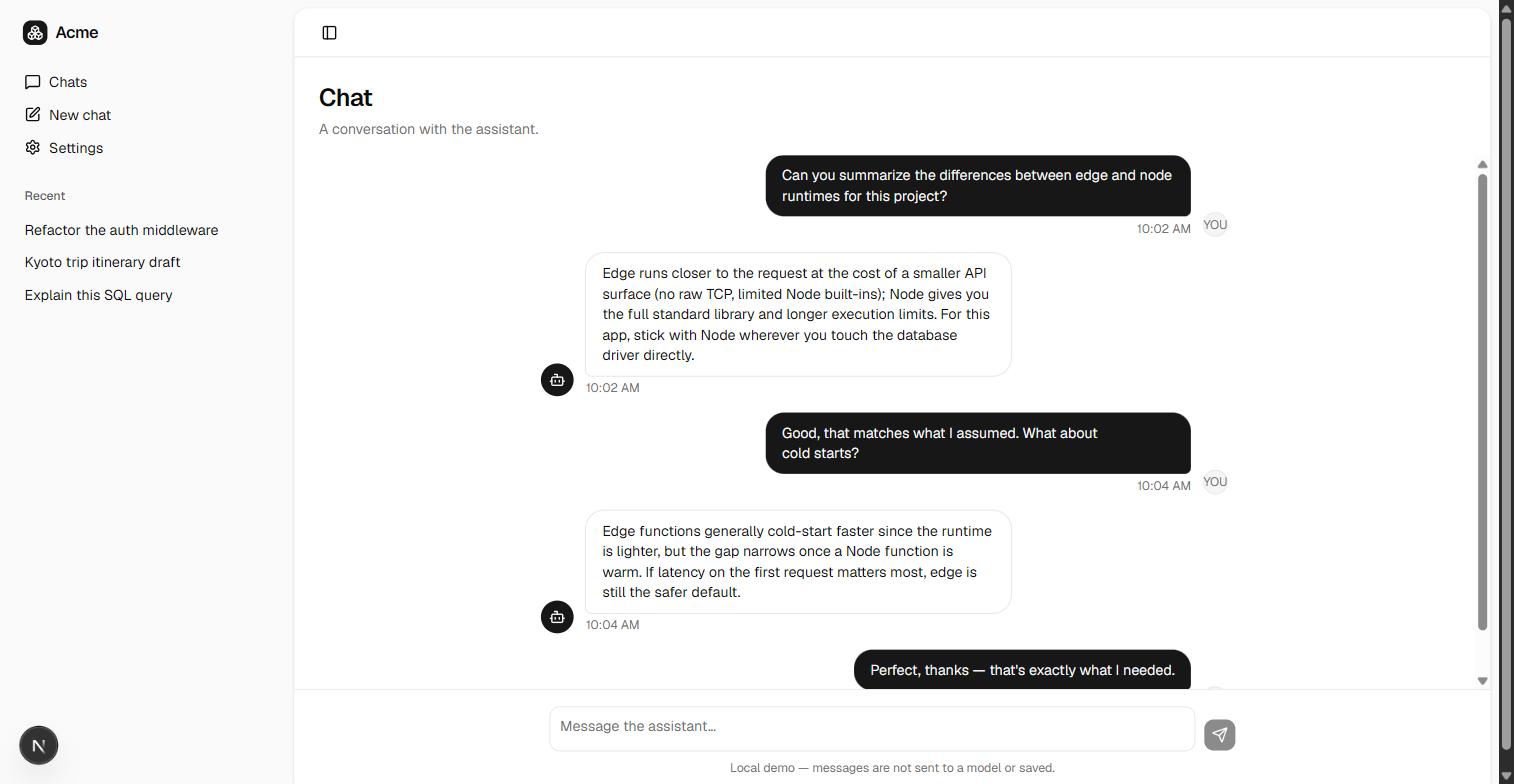
</template><script setup lang="ts">
import { BotIcon } from "lucide-vue-next"
import { Avatar, AvatarFallback } from "@/components/ui/avatar"
import ChatComposer from "@/components/chat-composer.vue"
import { cn } from "@/lib/utils"
// Chat archetype home (behind the auth-gated dashboard layout). Static sample conversation + the
// composer island. ponytail: no model is called here — scaffold only.
definePageMeta({ layout: "dashboard", middleware: "auth" })
type ChatMessage = { id: string; role: "user" | "assistant"; content: string; timestamp: string }
const conversation: ChatMessage[] = [
{ id: "1", role: "user", content: "Can you summarize the differences between edge and node runtimes for this project?", timestamp: "10:02 AM" },
{ id: "2", role: "assistant", content: "Edge runs closer to the request at the cost of a smaller API surface (no raw TCP, limited Node built-ins); Node gives you the full standard library and longer execution limits. For this app, stick with Node wherever you touch the database driver directly.", timestamp: "10:02 AM" },
{ id: "3", role: "user", content: "Good, that matches what I assumed. What about cold starts?", timestamp: "10:04 AM" },
{ id: "4", role: "assistant", content: "Edge functions generally cold-start faster since the runtime is lighter, but the gap narrows once a Node function is warm. If latency on the first request matters most, edge is still the safer default.", timestamp: "10:04 AM" },
{ id: "5", role: "user", content: "Perfect, thanks — that's exactly what I needed.", timestamp: "10:05 AM" },
]
</script>
<template>
<div class="flex h-[calc(100svh-3rem)] flex-col">
<div class="flex flex-col gap-1 p-4 pb-4 lg:p-6 lg:pb-4">
<h1 class="text-2xl font-semibold tracking-tight">Chat</h1>
<p class="text-muted-foreground text-sm">A conversation with the assistant.</p>
</div>
<div class="flex-1 overflow-y-auto px-4 lg:px-6">
<div class="mx-auto flex max-w-2xl flex-col gap-4 pb-6">
<div
v-for="message in conversation"
:key="message.id"
:class="cn('flex items-end gap-3', message.role === 'user' && 'flex-row-reverse')"
>
<span
v-if="message.role === 'assistant'"
aria-hidden="true"
class="bg-primary text-primary-foreground flex size-8 shrink-0 items-center justify-center rounded-full"
>
<BotIcon class="size-4" />
</span>
<Avatar v-else class="size-7">
<AvatarFallback>YOU</AvatarFallback>
</Avatar>
<div class="flex flex-col gap-1">
<div
:class="cn(
'max-w-[26rem] rounded-2xl px-4 py-2.5 text-sm text-pretty',
message.role === 'user'
? 'bg-primary text-primary-foreground rounded-br-sm'
: 'bg-card ring-foreground/10 rounded-bl-sm ring-1',
)"
>
<span class="sr-only">{{ message.role === "user" ? "You said: " : "Assistant said: " }}</span>
{{ message.content }}
</div>
<span :class="cn('text-muted-foreground text-xs', message.role === 'user' && 'text-right')">
{{ message.timestamp }}
</span>
</div>
</div>
</div>
</div>
<ChatComposer />
</div>
</template>Email — verified (Resend)
<mjml lang="en">
<mj-head>
<mj-title>Welcome aboard</mj-title>
<mj-attributes>
<mj-all font-family="-apple-system, BlinkMacSystemFont, 'Segoe UI', Helvetica, Arial, sans-serif" />
</mj-attributes>
</mj-head>
<mj-body background-color="#f4f4f5">
<mj-raw><div style="display:none;overflow:hidden;line-height:1px;opacity:0;max-height:0;max-width:0;">You're in — here's how to get started.</div></mj-raw>
<mj-section background-color="#ffffff" padding="32px" border-radius="8px">
<mj-column>
<mj-text color="#111827" font-size="22px" font-weight="700">Welcome, {{name}}!</mj-text>
<mj-text color="#374151" font-size="15px" line-height="24px">Thanks for signing up. Your account is ready to go.</mj-text>
<mj-text color="#374151" font-size="15px" line-height="24px">If you have any questions, just reply to this email — a real person reads it.</mj-text>
<mj-raw>
<table role="presentation" cellpadding="0" cellspacing="0" style="margin:24px 0;">
<tr>
<td style="border-radius:6px;background-color:#111827;" align="center">
<a href="{{ctaUrl}}" style="display:inline-block;padding:12px 20px;font-size:15px;font-weight:600;color:#ffffff;background-color:#111827;border-radius:6px;text-decoration:none;font-family:-apple-system, BlinkMacSystemFont, 'Segoe UI', Helvetica, Arial, sans-serif;">Go to your dashboard</a>
</td>
</tr>
</table>
</mj-raw>
<mj-divider border-color="#e5e7eb" />
<mj-text color="#4b5563" font-size="12px" line-height="18px">Acme Inc, 548 Market St PMB 12345, San Francisco, CA 94104</mj-text>
<mj-text color="#4b5563" font-size="12px" line-height="18px"><a href="{{unsubscribeUrl}}" style="color:#4b5563;text-decoration:underline;">Unsubscribe</a></mj-text>
</mj-column>
</mj-section>
</mj-body>
</mjml><mjml lang="en">
<mj-head>
<mj-title>You have a new notification</mj-title>
<mj-attributes>
<mj-all font-family="-apple-system, BlinkMacSystemFont, 'Segoe UI', Helvetica, Arial, sans-serif" />
</mj-attributes>
</mj-head>
<mj-body background-color="#f4f4f5">
<mj-raw><div style="display:none;overflow:hidden;line-height:1px;opacity:0;max-height:0;max-width:0;">Something happened in your account.</div></mj-raw>
<mj-section background-color="#ffffff" padding="32px" border-radius="8px">
<mj-column>
<mj-text color="#111827" font-size="22px" font-weight="700">{{title}}</mj-text>
<mj-text color="#374151" font-size="15px" line-height="24px">Hi {{name}},</mj-text>
<mj-text color="#374151" font-size="15px" line-height="24px">{{message}}</mj-text>
<mj-raw>
<table role="presentation" cellpadding="0" cellspacing="0" style="margin:24px 0;">
<tr>
<td style="border-radius:6px;background-color:#111827;" align="center">
<a href="{{ctaUrl}}" style="display:inline-block;padding:12px 20px;font-size:15px;font-weight:600;color:#ffffff;background-color:#111827;border-radius:6px;text-decoration:none;font-family:-apple-system, BlinkMacSystemFont, 'Segoe UI', Helvetica, Arial, sans-serif;">View details</a>
</td>
</tr>
</table>
</mj-raw>
<mj-divider border-color="#e5e7eb" />
<mj-text color="#4b5563" font-size="12px" line-height="18px">Acme Inc, 548 Market St PMB 12345, San Francisco, CA 94104</mj-text>
<mj-text color="#4b5563" font-size="12px" line-height="18px"><a href="{{unsubscribeUrl}}" style="color:#4b5563;text-decoration:underline;">Unsubscribe</a></mj-text>
</mj-column>
</mj-section>
</mj-body>
</mjml>import { Resend } from "resend";
import mjml2html from "mjml";
// Constructed LAZILY, on first send. `new Resend(undefined)` THROWS ("Missing API key"),
// and a module-scope client makes that throw fire at IMPORT time — which is exactly when a
// framework build imports this file to collect page data. The result is that `next build`
// fails outright on any machine without RESEND_API_KEY set (CI, a fresh clone, a preview
// deploy that only holds runtime secrets). Deferring it means importing lib/email is always
// safe and a missing key fails at the send, where it is actionable.
let client: Resend | undefined;
function resendClient(): Resend {
return (client ??= new Resend(process.env.RESEND_API_KEY));
}
const FROM = process.env.EMAIL_FROM ?? "onboarding@resend.dev";
const WELCOME_MJML = `<mjml lang="en">
<mj-head>
<mj-title>Welcome aboard</mj-title>
<mj-attributes>
<mj-all font-family="-apple-system, BlinkMacSystemFont, 'Segoe UI', Helvetica, Arial, sans-serif" />
</mj-attributes>
</mj-head>
<mj-body background-color="#f4f4f5">
<mj-raw><div style="display:none;overflow:hidden;line-height:1px;opacity:0;max-height:0;max-width:0;">You're in — here's how to get started.</div></mj-raw>
<mj-section background-color="#ffffff" padding="32px" border-radius="8px">
<mj-column>
<mj-text color="#111827" font-size="22px" font-weight="700">Welcome, {{name}}!</mj-text>
<mj-text color="#374151" font-size="15px" line-height="24px">Thanks for signing up. Your account is ready to go.</mj-text>
<mj-text color="#374151" font-size="15px" line-height="24px">If you have any questions, just reply to this email — a real person reads it.</mj-text>
<mj-raw>
<table role="presentation" cellpadding="0" cellspacing="0" style="margin:24px 0;">
<tr>
<td style="border-radius:6px;background-color:#111827;" align="center">
<a href="{{ctaUrl}}" style="display:inline-block;padding:12px 20px;font-size:15px;font-weight:600;color:#ffffff;background-color:#111827;border-radius:6px;text-decoration:none;font-family:-apple-system, BlinkMacSystemFont, 'Segoe UI', Helvetica, Arial, sans-serif;">Go to your dashboard</a>
</td>
</tr>
</table>
</mj-raw>
<mj-divider border-color="#e5e7eb" />
<mj-text color="#4b5563" font-size="12px" line-height="18px">Acme Inc, 548 Market St PMB 12345, San Francisco, CA 94104</mj-text>
<mj-text color="#4b5563" font-size="12px" line-height="18px"><a href="{{unsubscribeUrl}}" style="color:#4b5563;text-decoration:underline;">Unsubscribe</a></mj-text>
</mj-column>
</mj-section>
</mj-body>
</mjml>`;
const NOTIFICATION_MJML = `<mjml lang="en">
<mj-head>
<mj-title>You have a new notification</mj-title>
<mj-attributes>
<mj-all font-family="-apple-system, BlinkMacSystemFont, 'Segoe UI', Helvetica, Arial, sans-serif" />
</mj-attributes>
</mj-head>
<mj-body background-color="#f4f4f5">
<mj-raw><div style="display:none;overflow:hidden;line-height:1px;opacity:0;max-height:0;max-width:0;">Something happened in your account.</div></mj-raw>
<mj-section background-color="#ffffff" padding="32px" border-radius="8px">
<mj-column>
<mj-text color="#111827" font-size="22px" font-weight="700">{{title}}</mj-text>
<mj-text color="#374151" font-size="15px" line-height="24px">Hi {{name}},</mj-text>
<mj-text color="#374151" font-size="15px" line-height="24px">{{message}}</mj-text>
<mj-raw>
<table role="presentation" cellpadding="0" cellspacing="0" style="margin:24px 0;">
<tr>
<td style="border-radius:6px;background-color:#111827;" align="center">
<a href="{{ctaUrl}}" style="display:inline-block;padding:12px 20px;font-size:15px;font-weight:600;color:#ffffff;background-color:#111827;border-radius:6px;text-decoration:none;font-family:-apple-system, BlinkMacSystemFont, 'Segoe UI', Helvetica, Arial, sans-serif;">View details</a>
</td>
</tr>
</table>
</mj-raw>
<mj-divider border-color="#e5e7eb" />
<mj-text color="#4b5563" font-size="12px" line-height="18px">Acme Inc, 548 Market St PMB 12345, San Francisco, CA 94104</mj-text>
<mj-text color="#4b5563" font-size="12px" line-height="18px"><a href="{{unsubscribeUrl}}" style="color:#4b5563;text-decoration:underline;">Unsubscribe</a></mj-text>
</mj-column>
</mj-section>
</mj-body>
</mjml>`;
// MJML has no built-in variable binding — templates carry {{token}} mail-merge
// placeholders (see templates-mjml.ts); substitute before compiling.
function fill(template: string, vars: Record<string, string>): string {
return template.replace(/\{\{(\w+)\}\}/g, (_match, key: string) => vars[key] ?? "");
}
async function renderMjml(template: string, vars: Record<string, string>): Promise<string> {
const { html, errors } = await mjml2html(fill(template, vars), { validationLevel: "soft" });
// The ambient mjml.d.ts below deliberately types errors as unknown[] (no upstream .d.ts to
// pin against); mjml's real runtime error objects carry .formattedMessage, so assert it here.
if (errors.length > 0) throw new Error(`mjml: ${errors.map((e) => (e as { formattedMessage: string }).formattedMessage).join("; ")}`);
return html;
}
export async function sendWelcome(to: string, vars: { name: string; ctaUrl: string; unsubscribeUrl: string }) {
const html = await renderMjml(WELCOME_MJML, vars);
return resendClient().emails.send({ from: FROM, to, subject: "Welcome aboard", html });
}
export async function sendNotification(to: string, vars: { name: string; title: string; message: string; ctaUrl: string; unsubscribeUrl: string }) {
const html = await renderMjml(NOTIFICATION_MJML, { ...vars, title: vars.title });
return resendClient().emails.send({ from: FROM, to, subject: vars.title, html });
}// mjml@5 ships no type declarations for its default export — this ambient module fills the gap.
declare module "mjml" {
export default function mjml2html(
src: string,
opts?: { validationLevel?: "strict" | "soft" | "skip" },
): Promise<{ html: string; errors: unknown[] }>;
}Decisions and compatibility
Client/server split: the DB client, Drizzle schema, records, and webhooks are server-side (server/). The `@/` alias is the client root (app/); server code reaches shared modules via Nuxt's `~~` rootDir alias (e.g. `~~/server/db/schema`).
The API layer is Nitro, Nuxt's server engine: endpoints are server/api/*.post.ts route handlers, and auth mounts as a Nitro catch-all that delegates to the auth library's framework-agnostic web handler.
Nuxt auto-imports components and composables at runtime, but the emitted server code imports h3 helpers (defineEventHandler, toWebRequest) EXPLICITLY — the one deliberate idiom trade so the handlers type-check under standalone tsc instead of relying on the auto-import magic.
Session gating runs in a Nitro server middleware (server/middleware/), which fires on every SSR and API request — the true security boundary, and a real server-side session check rather than a cookie-existence peek.
mysql2's pool multiplexes connections; drizzle-orm/mysql2 wraps it. One module-level pool is right for a serverless/edge app — the runtime and the pool handle concurrency.
MySQL has no row-level security: multi-tenant isolation is enforced in application code via the forOrg helper (src/lib/tenant.ts), not by the database. See the tenant-scoping section on SaaS pages.
Hosted: Supabase owns identity in its managed auth.users. This stack emits a LOCAL `user` mirror (db/auth-schema.ts) so app-type schemas can foreign-key `user` directly — keep it in sync with a Supabase trigger on auth.users (insert/update → public.user). The drizzle migration only owns the mirror table's shape, not the trigger.
Sessions are cookie-based (@supabase/ssr): the proxy refreshes them on every request; Server Components read the user via supabase.auth.getUser().
user_profiles.userId carries a UNIQUE constraint — it is the 1:1 extension of Better Auth's user row; the FK itself is the identity, so no separate join table is needed.
token_usage is append-only and stores cost as costMicrocents (bigint integer): no float money, fine-grained enough for sub-cent per-token pricing without a numeric type.
MySQL provides no row-level security. On MySQL, multi-tenant isolation is APP-ENFORCED via the forOrg helper (src/lib/tenant.ts), not database-enforced like Postgres RLS. Every org-scoped query MUST go through forOrg — a missed query leaks across tenants. Postgres cells enforce this in the database itself (RLS), so it holds even for a query that forgets to scope.
Recombine
Swap one axis and keep the rest. Every combination below is verified the same way.