Forum / community on Next.js 16 (App Router), Postgres (Neon) and Auth.js (NextAuth)
Forum / community: slug-keyed category taxonomy, threaded discussions with open/locked status and pinning, and per-reply up/down votes.
54 files, 4 tables and 143 lines of schema, verified 2026-08-23 on Next.js 16 (App Router), Postgres (Neon) and Auth.js (NextAuth).
15 pinned upstream versions
request path. session validation runs in server components and route handlers, not at the edge
What you're getting
Next.js 16 App Router: file-based routing, server components, and the Edge proxy (Next 16's renamed middleware).
Postgres on Neon via Drizzle ORM and the postgres-js driver.
Auth.js (NextAuth v5): self-hosted OAuth running inside your app against your database (Drizzle adapter).
Forum / community: slug-keyed category taxonomy, threaded discussions with open/locked status and pinning, and per-reply up/down votes.
Setup
bun add next react react-dom drizzle-orm postgres next-auth @auth/drizzle-adapterDATABASE_URLNeon pooled (-pooler) connection stringAUTH_SECRETgenerate with `npx auth secret` (or `openssl rand -base64 32`)AUTH_GITHUB_IDGitHub OAuth app client idAUTH_GITHUB_SECRETGitHub OAuth app client secretApply the schema with bunx drizzle-kit push
Initialization
Database client
Forum / community schema: categories, threads, replies & votes
4 tables, 21 columns and 11 indexes and constraints, applied to a live Postgres (Neon) and asserted to materialize.
categories4 columns · 3 indexedthreads7 columns · 3 indexedthread_replies5 columns · 3 indexedreply_votes5 columns · 2 indexedWhat this schema is built to answer
categories.slug is unique and indexed by idx_category_slug for the URL; idx_thread_category on threads.category_id pulls that category's threads. Pinned-first ordering comes from the is_pinned boolean and is sorted after the index hit, not stored.
idx_reply_thread on thread_replies.thread_id returns a whole thread in one index range. There is no parent-reply column, so nothing recursive is involved — replies are flat by construction.
reply_votes_reply_voter_unique leads with reply_id, so sum(value) for a reply rides that unique index; reply_votes_value_check restricts value to -1 or 1, which is what makes the sum a plain ups-minus-downs score.
The (reply_id, voter_id) unique is the upsert key: turning an up-vote into a down-vote is one write against the existing row. Zero fails the CHECK, so retracting is a delete instead of a value update.
idx_thread_author and idx_reply_author cover both sides of what a member wrote, and threads.author_id, thread_replies.author_id and reply_votes.voter_id all cascade from user.id, so removing an account clears the trail without a cleanup pass.
Categories taxonomyslug-unique top-level categories each thread must belong to exactly one of
Threads (status & pinning)threads scoped to a category and author, with open/locked status and an is_pinned flag for surfacing
Thread repliesflat replies within a thread, each carrying a body and an author FK into Better Auth's user table
Reply votesappend-style up/down votes on replies, uniquely constrained per (reply, voter) pair
Deploy targets
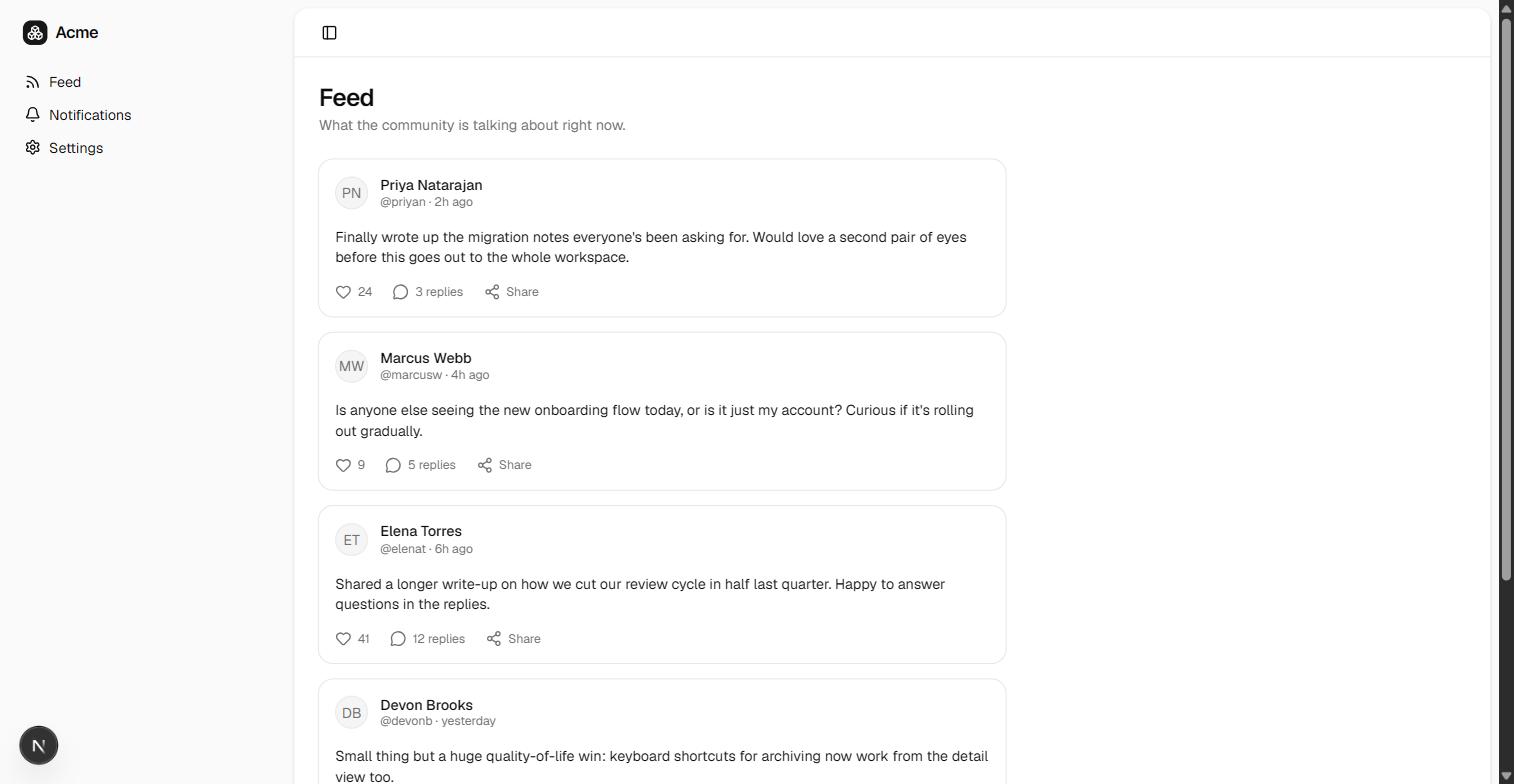
The app UI
Decisions and compatibility
Auth runs in proxy.ts (Next 16's renamed middleware) on the Edge runtime: it gates on the session cookie's presence only — full session validation happens in Server Components and route handlers, not in the proxy.
prepare: false is mandatory — Neon's pooled endpoint is PgBouncer in transaction mode, where server-side prepared statements break across the pool.
Drizzle is paired here (not Prisma): Prisma's prepared-statement reliance is incompatible with transaction-mode pooling.
Self-hosted + OAuth-first: NextAuth owns the user/account/session/verificationToken tables (Auth.js Drizzle schema). This stack emits them (db/auth-schema.ts) and hands them to the Drizzle adapter, so app-type schemas can foreign-key `user` directly.
OAuth (GitHub) is wired by default — sign-in creates the account, so there is no separate email-signup step. Swap or add providers in src/lib/auth.ts.
Vote identity is enforced by a composite unique on (reply_id, voter_id): one vote per reply per voter, value constrained to (-1, 1) via CHECK rather than a separate enum.
Thread status uses text + CHECK ('open','locked') so new statuses ship without an ALTER TYPE migration; the same pattern applies to vote value.
How this stack fits together
On Next.js 16 (App Router) this stack puts its Postgres (Neon) client at src/lib/db.ts and the Auth.js (NextAuth) instance at src/lib/auth.ts, with the auth route at src/app/api/auth/[...nextauth]/route.ts and session checks in src/proxy.ts. Those are the paths this framework's adapter actually emits, not a shared convention: the same Forum / community schema and the same Auth.js (NextAuth) wiring land somewhere different on each of the other frameworks in the registry.
Auth.js (NextAuth) owns its identity tables in the same database as categories, threads, thread_replies and reply_votes, so the foreign keys reference the local user row directly and a delete cascades through them. No mirror, no webhook, and no window where the two stores disagree.
Postgres (Neon) stores those surrogate keys as uuid, so every foreign key across the 4 tables and 21 columns below is a uuid column. The migration was applied to a live Postgres (Neon) and the tables asserted, not just type-checked.
Forum / community
Everything here hangs off one containment chain: a category holds threads, a thread holds replies, a reply holds votes, and every link in that chain is onDelete cascade. Dropping a category takes its threads, their replies and those replies' votes with it, which is convenient — and the reason a merge-two-categories feature has to rewrite threads.category_id rather than delete anything. idx_thread_category is what makes both that rewrite and the category front page cheap. Replies are flat. thread_replies has a thread_id and an author_id and no parent column, so a discussion is a list rather than a tree; nesting would be a schema change, not a query change. The upside is a trivial read path — idx_reply_thread returns an entire thread in one index range, in the order it was written.
Two moderation levers sit on threads and they are shaped differently on purpose. status is text guarded by threads_status_check to 'open' or 'locked', so introducing 'archived' later is a rewritten CHECK instead of an ALTER TYPE. is_pinned is a plain boolean, meaning a pin is a flag the listing sorts on rather than a stored position: idx_thread_category narrows to the category, and the pinned-first ordering happens on top of that. Neither lever is enforced against writes — nothing in the database refuses a reply on a locked thread, so the lock is a rule the handler applies. Votes are where a constraint carries real weight.
reply_votes keeps a surrogate id, but its identity is reply_votes_reply_voter_unique on (reply_id, voter_id): one voter, one vote per reply, upserted on that pair when someone flips an up-vote to a down-vote. value is an integer restricted by reply_votes_value_check to -1 or 1, so zero is not a legal value and retracting a vote is a delete rather than an update. Score is therefore always sum(value) taken over the leading reply_id column of that unique index, with no cached total on thread_replies to drift out of sync. Member-level moderation comes from the other side, through idx_thread_author and idx_reply_author.
Next.js 16 (App Router)
Next 16's App Router keeps the whole application under src/: the scaffold runs create-next-app with --src-dir and --import-alias @/*, so `@/` resolves to src/* and the verified files land on top of a stock project rather than replacing it. initCode writes the database client to src/lib/db.ts, then appends the auth fragment's own files — identity tables at src/db/auth-schema.ts, the auth instance at src/lib/auth.ts, a catch-all handler under src/app/api/auth/, and src/proxy.ts. Each file has exactly one owner; the framework never re-emits the ones auth brought. Server code has two shapes here and they are not interchangeable. A Server Component runs on the server and imports { db } from "@/lib/db" directly, so a page can await a Drizzle query with no API route in between.
Anything that needs a URL — an OAuth callback, a Polar or Clerk webhook, a mutation posted from the client — is a route handler at src/app/api/<path>/route.ts exporting GET or POST. Session checking is split across two tiers on purpose. src/proxy.ts (Next 16's rename of middleware.ts; under --src-dir it must sit beside src/app or Next silently ignores it) runs on the Edge runtime with a config.matcher listing the guarded prefixes — /dashboard/:path* and /settings/:path* out of the box. It only asks whether a session cookie exists and redirects to /sign-in when it does not: no database round trip at the edge. The authoritative check is auth.api.getSession() inside the Server Component or route handler that actually reads rows.
What that means when you build on it: widening the protected surface is a one-line change to the matcher array, but the proxy is not the security boundary — a request carrying any session cookie reaches the page, and the page decides. Keep the real check next to the data. The UI overlay follows the same split, with auth screens under src/app/(auth)/ and the shell and dashboard under src/app/(app)/.
Postgres (Neon)
Postgres here is Neon reached through postgres-js, with Drizzle's pg-core dialect on top: drizzle({ client }) over a single module-level postgres(DATABASE_URL, { prepare: false }). That flag is not a preference. Neon's pooled (-pooler) endpoint is PgBouncer in transaction mode, where a backend is handed to a different session between statements, so server-side prepared statements break across the pool — and the same constraint is why this axis pairs with Drizzle rather than Prisma. One client per module is enough: PgBouncer and the runtime do the pooling, so there is no globalThis singleton dance. The schemas built on this dialect make three recurring type decisions. Primary keys are uuid(...).primaryKey().defaultRandom(), so ids come from the database. Timestamps are timestamp(..., { withTimezone: true }).defaultNow() — timestamptz, an absolute instant.
Closed value sets are text plus a CHECK constraint rather than pgEnum, so shipping a new role or subscription status is an ordinary constraint change instead of an ALTER TYPE migration. Counters are bigint({ mode: "number" }), and Better Auth's text user.id is referenced as text by the app tables rather than recast. Operationally, transaction-mode pooling forbids anything that spans statements on one backend: LISTEN/NOTIFY, session-scoped SET, advisory-lock sessions, WITH HOLD cursors. Those paths use Neon's direct endpoint instead. The connection client also changes with the deploy target — max: 1 per short-lived serverless instance, a real reused pool (max 10, idle_timeout 20) in a long-running Node process, and on Cloudflare Workers postgres-js is replaced outright by @neondatabase/serverless over HTTP, because Workers have no TCP sockets.
The capability that exists only on this side of the matrix is row-level security. Multi-tenant schemas ship ENABLE plus FORCE ROW LEVEL SECURITY with policies keyed on current_setting('app.current_org_id', true), which withTenant() sets per transaction — unset context yields no rows, so isolation fails closed inside the database rather than in application code. It requires a dedicated NOBYPASSRLS role: Neon's default neondb_owner carries BYPASSRLS, and connecting as it makes every policy silently inert.
Auth.js (NextAuth)
Auth.js v5 — still shipped as the next-auth package — runs inside your app and stores identity in your own database, but the shape it assumes is OAuth-first, and that decides most of what this cell looks like. No password is stored anywhere in the emitted schema. Sign-up and sign-in are the same act: the vendored screen is one "Continue with GitHub" button calling signIn("github", { redirectTo: "/dashboard" }), and the first successful callback is what creates the row. The identity tables are the canonical @auth/drizzle-adapter set, authored into db/auth-schema.ts as user, account, session and verificationToken. Their keys are worth reading before building on them.
account has no id of its own; its primary key is the composite (provider, providerAccountId), so one user row can hold several provider accounts, one per pair, each cascading from user.id. session is keyed by sessionToken and carries an expires timestamp — this is a database-session setup, not a JWT one, so signing out deletes a row and revocation is a DELETE you can run yourself. user.id is a text (varchar(255) on MySQL) primary key filled by $defaultFn(() => crypto.randomUUID()), and app-type schemas foreign-key it directly. src/lib/auth.ts hands all four tables to DrizzleAdapter explicitly through usersTable / accountsTable / sessionsTable / verificationTokensTable, so the adapter writes this schema rather than looking for its own default table names.
NextAuth's factory returns handlers, auth, signIn and signOut in a single destructure, and each of those lands somewhere specific in the emitted files. handlers is re-exported as GET and POST from src/app/api/auth/[...nextauth]/route.ts, which is where sign-in, callback, session and CSRF requests all terminate. auth is used twice at different strengths: wrapped as the proxy in src/proxy.ts, where a null req.auth redirects traffic off /dashboard and /settings, and called directly inside requireUser() in src/lib/session.ts for the real per-render check. <SessionProvider> in the root layout is what makes useSession() and signOut() work in the sidebar's nav-user. Two constraints follow. This adapter is pinned to Next through supportedFrameworks, because next-auth is Next-specific — React Router and Nuxt would need @auth/core instead.
And because GitHub already verified the address, there is no verify-email or reset-password flow here to wire: composing an email fragment gets you events.createUser calling sendWelcome once the adapter has persisted the user, and nothing more. Adding email or magic-link sign-in means adding a provider yourself, which changes the sign-in surface.