Fintech ledger on Next.js 16 (App Router), Postgres (Neon) and Better Auth
Double-entry fintech ledger: chart of accounts, immutable journal entries, and debit/credit lines with integer-cent amounts.
62 files, 3 tables and 70 lines of schema, verified 2026-08-23 on Next.js 16 (App Router), Postgres (Neon) and Better Auth.
15 pinned upstream versions
request path. session validation runs in server components and route handlers, not at the edge
What you're getting
Next.js 16 App Router: file-based routing, server components, and the Edge proxy (Next 16's renamed middleware).
Postgres on Neon via Drizzle ORM and the postgres-js driver.
Better Auth: self-hosted auth running inside your app against your Postgres (Drizzle adapter).
Double-entry fintech ledger: chart of accounts, immutable journal entries, and debit/credit lines with integer-cent amounts.
Setup
bun add next react react-dom drizzle-orm postgres better-authDATABASE_URLNeon pooled (-pooler) connection stringBETTER_AUTH_SECRETgenerate with `openssl rand -base64 32`BETTER_AUTH_URLyour app's base URLApply the schema with bunx drizzle-kit push
Initialization
Database client
Double-entry ledger schema: accounts, journal entries & lines
3 tables, 15 columns and 7 indexes and constraints, applied to a live Postgres (Neon) and asserted to materialize.
accounts6 columns · 2 indexedjournal_entries4 columns · 2 indexedjournal_lines5 columns · 3 indexedWhat this schema is built to answer
idx_line_account on journal_lines.account_id, summing amount_cents grouped by direction and netting debits against credits. There is no stored balance to read instead, and none to reconcile.
idx_line_entry gathers every line for an entry_id in a single range, and journal_lines_direction_check guarantees each one is a debit or a credit, so both sides total without a lookup anywhere else.
The same idx_line_entry range, run inside the writing transaction. The database guards only the direction domain — no constraint spans the lines of an entry — so this check is application code or it does not happen.
idx_entry_posted on journal_entries.posted_at. posted_at is the only time column on the posting path; journal_lines carries none, so a period is always selected on the header and expanded through idx_line_entry.
idx_account_owner on accounts.owner_id picks the account set, then idx_line_account sums each account's lines. Ownership never appears on journal_lines, so there is no shortcut from a user straight to their postings.
Chart of accountsper-owner accounts typed to one of five standard categories (asset/liability/equity/revenue/expense)
Journal entriesimmutable header rows tying a description and posted timestamp to a creator
Debit/credit lines & balancesthe individual debit/credit lines linking each journal entry to an account with an integer-cent amount
Deploy targets
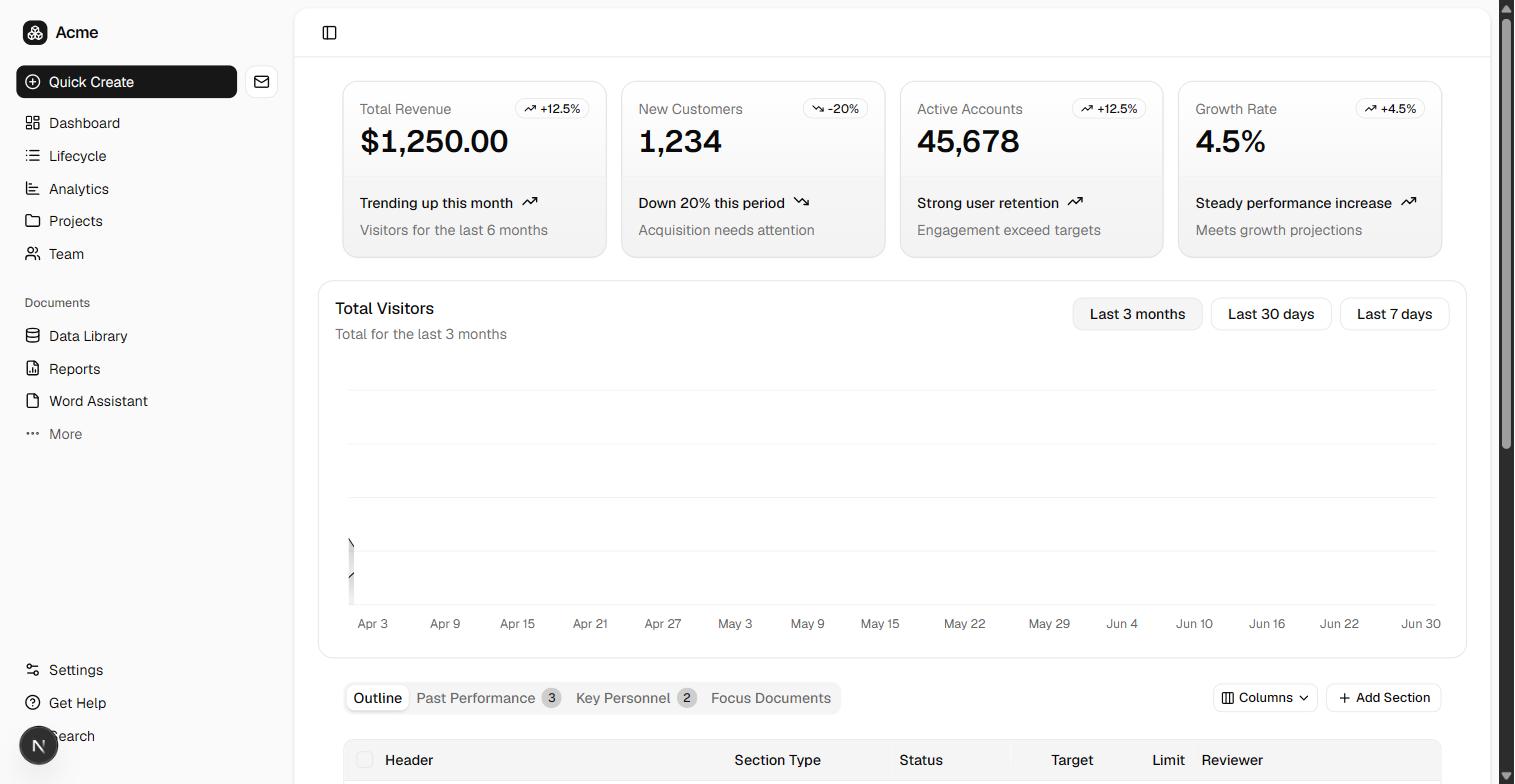
The app UI
Decisions and compatibility
Auth runs in proxy.ts (Next 16's renamed middleware) on the Edge runtime: it gates on the session cookie's presence only — full session validation happens in Server Components and route handlers, not in the proxy.
prepare: false is mandatory — Neon's pooled endpoint is PgBouncer in transaction mode, where server-side prepared statements break across the pool.
Drizzle is paired here (not Prisma): Prisma's prepared-statement reliance is incompatible with transaction-mode pooling.
Self-hosted: Better Auth owns the user/session/account/verification tables. This stack emits them (db/auth-schema.ts) and hands them to the Drizzle adapter, so app-type schemas can foreign-key `user` directly.
The accounts table constrains type to the five canonical categories (asset/liability/equity/revenue/expense) via a DB CHECK — adding a new account class requires a migration, not just app code.
Debit/credit balance (sum of debits == sum of credits per entry) is enforced in application logic, not at the DB level; the schema's CHECK only guards direction values ('debit'/'credit'), so the invariant can be violated if bypassed.
How this stack fits together
On Next.js 16 (App Router) this stack puts its Postgres (Neon) client at src/lib/db.ts and the Better Auth instance at src/lib/auth.ts, with the auth route at src/app/api/auth/[...all]/route.ts and session checks in src/proxy.ts. Those are the paths this framework's adapter actually emits, not a shared convention: the same Fintech ledger schema and the same Better Auth wiring land somewhere different on each of the other frameworks in the registry.
Better Auth owns its identity tables in the same database as accounts, journal_entries and journal_lines, so the foreign keys reference the local user row directly and a delete cascades through them. No mirror, no webhook, and no window where the two stores disagree.
Postgres (Neon) stores those surrogate keys as uuid, so every foreign key across the 3 tables and 15 columns below is a uuid column. The migration was applied to a live Postgres (Neon) and the tables asserted, not just type-checked.
Fintech ledger
No table here has a balance column, and that absence is the design. An account's balance is a sum over journal_lines — grouped by direction, one side netted against the other — served by idx_line_account on account_id. Nothing is cached, so nothing can quietly fall out of agreement with the postings that produced it; the price is that every balance read is an aggregate, and a busy account grows a longer scan every month it stays open. accounts is the chart: a name, a currency defaulting to USD, and a type held to the five canonical classes by accounts_type_check — asset, liability, equity, revenue, expense. A sixth account class is a migration, not a config change.
journal_entries is the header, carrying a description, a creator_id into Better Auth's user, and posted_at behind idx_entry_posted. Notice what that index is not: it keys on time alone with no owner in it, so closing a period reads the whole book's window cheaply while a single owner's statement takes the other route entirely — accounts via idx_account_owner, then lines via idx_line_account. journal_lines is where the money sits. Each line points at an entry and an account, both indexed by idx_line_entry and idx_line_account, and carries a direction held to debit or credit by journal_lines_direction_check plus an amount_cents bigint. Integers, never floats — and the sign is carried by direction rather than by the number, though nothing constrains amount_cents to be positive, so that convention is yours to hold.
The invariant that defines double-entry, debits equalling credits within an entry, has no representation in this schema at all: no trigger, no deferred constraint, no CHECK spanning rows. Both sides go in one transaction and the application asserts the sum before commit, because a half-written entry is a perfectly valid row set as far as the database is concerned. Currency compounds that — it lives on accounts and not on lines, so an entry touching a USD account and a EUR account has nowhere to record a rate, and a single-currency book is the assumed case. Deletes cascade from user through accounts and entries, taking every line with them: this is a live ledger, not an archive.
Next.js 16 (App Router)
Next 16's App Router keeps the whole application under src/: the scaffold runs create-next-app with --src-dir and --import-alias @/*, so `@/` resolves to src/* and the verified files land on top of a stock project rather than replacing it. initCode writes the database client to src/lib/db.ts, then appends the auth fragment's own files — identity tables at src/db/auth-schema.ts, the auth instance at src/lib/auth.ts, a catch-all handler under src/app/api/auth/, and src/proxy.ts. Each file has exactly one owner; the framework never re-emits the ones auth brought. Server code has two shapes here and they are not interchangeable. A Server Component runs on the server and imports { db } from "@/lib/db" directly, so a page can await a Drizzle query with no API route in between.
Anything that needs a URL — an OAuth callback, a Polar or Clerk webhook, a mutation posted from the client — is a route handler at src/app/api/<path>/route.ts exporting GET or POST. Session checking is split across two tiers on purpose. src/proxy.ts (Next 16's rename of middleware.ts; under --src-dir it must sit beside src/app or Next silently ignores it) runs on the Edge runtime with a config.matcher listing the guarded prefixes — /dashboard/:path* and /settings/:path* out of the box. It only asks whether a session cookie exists and redirects to /sign-in when it does not: no database round trip at the edge. The authoritative check is auth.api.getSession() inside the Server Component or route handler that actually reads rows.
What that means when you build on it: widening the protected surface is a one-line change to the matcher array, but the proxy is not the security boundary — a request carrying any session cookie reaches the page, and the page decides. Keep the real check next to the data. The UI overlay follows the same split, with auth screens under src/app/(auth)/ and the shell and dashboard under src/app/(app)/.
Postgres (Neon)
Postgres here is Neon reached through postgres-js, with Drizzle's pg-core dialect on top: drizzle({ client }) over a single module-level postgres(DATABASE_URL, { prepare: false }). That flag is not a preference. Neon's pooled (-pooler) endpoint is PgBouncer in transaction mode, where a backend is handed to a different session between statements, so server-side prepared statements break across the pool — and the same constraint is why this axis pairs with Drizzle rather than Prisma. One client per module is enough: PgBouncer and the runtime do the pooling, so there is no globalThis singleton dance. The schemas built on this dialect make three recurring type decisions. Primary keys are uuid(...).primaryKey().defaultRandom(), so ids come from the database. Timestamps are timestamp(..., { withTimezone: true }).defaultNow() — timestamptz, an absolute instant.
Closed value sets are text plus a CHECK constraint rather than pgEnum, so shipping a new role or subscription status is an ordinary constraint change instead of an ALTER TYPE migration. Counters are bigint({ mode: "number" }), and Better Auth's text user.id is referenced as text by the app tables rather than recast. Operationally, transaction-mode pooling forbids anything that spans statements on one backend: LISTEN/NOTIFY, session-scoped SET, advisory-lock sessions, WITH HOLD cursors. Those paths use Neon's direct endpoint instead. The connection client also changes with the deploy target — max: 1 per short-lived serverless instance, a real reused pool (max 10, idle_timeout 20) in a long-running Node process, and on Cloudflare Workers postgres-js is replaced outright by @neondatabase/serverless over HTTP, because Workers have no TCP sockets.
The capability that exists only on this side of the matrix is row-level security. Multi-tenant schemas ship ENABLE plus FORCE ROW LEVEL SECURITY with policies keyed on current_setting('app.current_org_id', true), which withTenant() sets per transaction — unset context yields no rows, so isolation fails closed inside the database rather than in application code. It requires a dedicated NOBYPASSRLS role: Neon's default neondb_owner carries BYPASSRLS, and connecting as it makes every policy silently inert.
Better Auth
Better Auth is a TypeScript library, not a service. The process that serves your pages is the process that hashes passwords and issues sessions, and the session rows sit in the same database as your application data. This fragment authors the four tables Better Auth expects — user, session, account, verification — into db/auth-schema.ts and passes that module to drizzleAdapter(db, { provider, schema: authSchema }) inside lib/auth.ts. Better Auth never creates tables at runtime; its CLI normally generates them, and authoring them here means the identity schema goes through the same migration proof as the app-type tables.
user.id is a bare text primary key (varchar(255) on MySQL, which cannot index TEXT without a prefix length) carrying no database default, because Better Auth generates the id and sends it in the insert. That is precisely what lets an app-type schema foreign-key user.id and cascade on delete. Session validation happens at two different strengths, deliberately. Next's src/proxy.ts calls getSessionCookie(request), which only asks whether the cookie is present: it runs at the edge, touches no database, and exists to bounce logged-out traffic before render. The authoritative check is auth.api.getSession({ headers }), and it runs inside the protected surface — requireUser() in src/lib/session.ts on Next, requireAuth(request) in app/lib/require-auth.ts on React Router, and the Nitro handler at server/middleware/auth.ts on Nuxt.
The last two do the real lookup on every guarded request, since neither framework has an edge proxy to peek with. The remaining emitted files are the mount: toNextJsHandler(auth) behind a [...all] route on Next, a resource route delegating to auth.handler on React Router, an h3 catch-all wrapping toWebRequest on Nuxt, plus a Vue auth client there. The auth instance imports the db client the framework already exported, so both share one pooled connection. What you inherit is ownership. Sessions join to your own tables, a user delete is a foreign-key cascade rather than a sync job, and drift arrives through your lockfile instead of a vendor's release notes.
The same ownership is the cost: password recovery only delivers if an email fragment is composed in — Better Auth's own server returns 400 "Reset password isn't enabled" until emailAndPassword.sendResetPassword is set — and rotating BETTER_AUTH_SECRET is yours to schedule.