Blog / CMS on Next.js 16 (App Router), Postgres (Neon) and Clerk
Blog / CMS: authored posts with a draft→published→archived workflow, slug-keyed taxonomy (categories + tags via join), and moderated reader comments.
54 files, 3 tables and 154 lines of schema, verified 2026-08-23 on Next.js 16 (App Router), Postgres (Neon) and Clerk.
15 pinned upstream versions
request path. session validation runs in server components and route handlers, not at the edge
What you're getting
Next.js 16 App Router: file-based routing, server components, and the Edge proxy (Next 16's renamed middleware).
Postgres on Neon via Drizzle ORM and the postgres-js driver.
Clerk: hosted identity (sign-in UI, sessions, user management) mounted via middleware + provider.
Blog / CMS: authored posts with a draft→published→archived workflow, slug-keyed taxonomy (categories + tags via join), and moderated reader comments.
Setup
bun add next react react-dom drizzle-orm postgres @clerk/nextjsDATABASE_URLNeon pooled (-pooler) connection stringNEXT_PUBLIC_CLERK_PUBLISHABLE_KEYCLERK_SECRET_KEYCLERK_WEBHOOK_SECRETsvix secret that verifies Clerk webhook signaturesApply the schema with bunx drizzle-kit push
Initialization
Database client
Blog / CMS schema: posts, taxonomy & moderated comments
5 tables, 24 columns and 15 indexes and constraints, applied to a live Postgres (Neon) and asserted to materialize.
posts8 columns · 4 indexedcategories4 columns · 3 indexedtags4 columns · 3 indexedpost_tags2 columns · 3 indexedcomments6 columns · 2 indexedWhat this schema is built to answer
idx_post_status_published is a composite on (status, published_at): equality on 'published' then an ordered walk of the timestamp, so the listing needs no sort step.
posts.slug carries a unique constraint, making the lookup a single-row index hit; because comments.post_id and post_tags.post_id reference posts.id instead, editing a slug touches no foreign key.
tags.slug is unique with idx_tag_slug behind the URL, and idx_post_tags_tag on post_tags.tag_id collects every post carrying that tag — the reverse direction of the join's (post_id, tag_id) primary key.
post_tags has no surrogate key: (post_id, tag_id) is the primary key, so writing the tag set is an idempotent insert-on-conflict, and the leading post_id lists a post's tags without a second index.
comments.status defaults to 'pending' under comments_status_check ('pending', 'approved', 'spam'), and idx_comment_post fetches a post's thread; the approved-only filter is applied over that index, which is keyed on post_id alone.
Posts & publishing workflowthe posts table with slug-unique constraint, author FK into Better Auth's user, and a status/publishedAt pair that drives the published feed index
Taxonomy: categories & tagsthe slug-keyed categories and tags tables plus the post_tags join that attaches many tags to many posts
Comments & moderationthe comments table hanging off posts with a pending→approved→spam moderation status and per-post thread index
Verified identity sync (Clerk)
Deploy targets
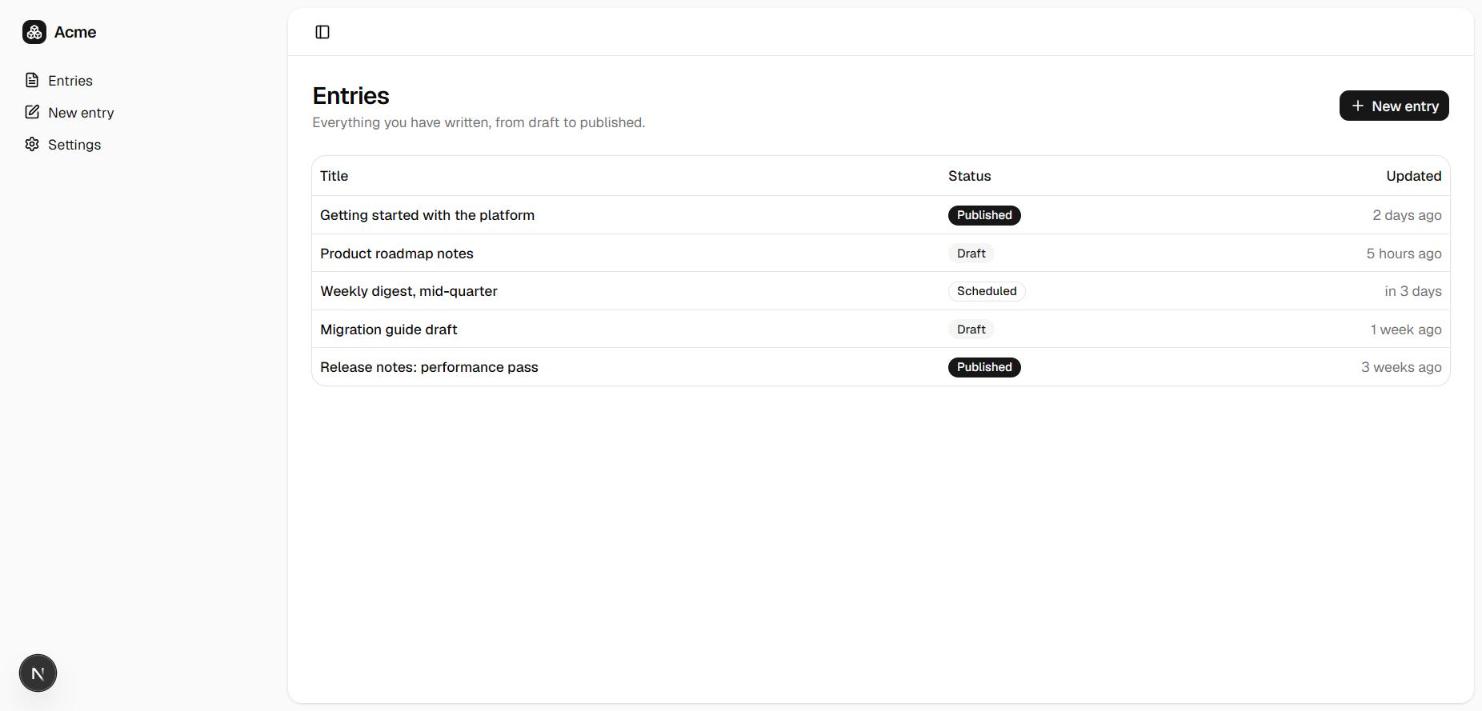
The app UI
Decisions and compatibility
Auth runs in proxy.ts (Next 16's renamed middleware) on the Edge runtime: it gates on the session cookie's presence only — full session validation happens in Server Components and route handlers, not in the proxy.
prepare: false is mandatory — Neon's pooled endpoint is PgBouncer in transaction mode, where server-side prepared statements break across the pool.
Drizzle is paired here (not Prisma): Prisma's prepared-statement reliance is incompatible with transaction-mode pooling.
Hosted: Clerk owns identity and does NOT create a local `user` table. Store `clerk_user_id` as text without a foreign key, or sync Clerk users into a local table via webhook before relying on FKs to `user`.
Route protection is clerkMiddleware() + auth.protect() in the Next proxy (getAuth() in a React Router loader, or event.context.auth() on Nuxt) — logged-out users bounce to Clerk's hosted sign-in, so there are no self-hosted auth pages to build or maintain.
Keeping the local mirror in sync is a webhook job: a svix-verified webhook route replays user.created / user.updated / user.deleted idempotently into the local `user` row, so app-type foreign keys to `user` resolve even though Clerk is the source of truth.
ClerkProvider (client) wraps the app so the hosted <SignIn/> / <UserButton/> components and hooks work; the publishable key is read client-side, while the secret key is only ever read server-side by clerkMiddleware.
post_tags is keyed by a composite primary key on (post_id, tag_id) — the tagging identity used by application-level upserts. (Postgres also carries a redundant explicit unique on the same columns; MySQL relies on the composite PK alone.)
Comments default to 'pending' and require explicit promotion to 'approved'; the CHECK on both posts and comments uses text + CHECK rather than pgEnum so new statuses ship without an ALTER TYPE migration.
Clerk is a hosted identity provider and does not create a local `user` table. This schema's foreign keys to `user` assume a local identity table (as Better Auth provides). With Clerk, store `clerk_user_id` as a text column without a foreign key, or sync Clerk users into a local `users` table via webhook before relying on these FKs.
How this stack fits together
Clerk is a hosted directory, so there is no local user row for posts, categories, tags, post_tags and comments to reference directly. The composer emits an identity mirror and a sync webhook instead, and the foreign keys point at the mirrored row, which is why this cell ships a webhook handler that the library-auth cells in this registry do not.
Postgres (Neon) stores those surrogate keys as uuid, so every foreign key across the 5 tables and 24 columns below is a uuid column. The migration was applied to a live Postgres (Neon) and the tables asserted, not just type-checked.
Blog / CMS
The publishing workflow is not a side field on this schema — it is the column the read path turns on. posts.status is text constrained by posts_status_check to 'draft', 'published' or 'archived', and idx_post_status_published indexes (status, published_at) in that order: equality on the status, then an ordered walk of the timestamp. The public index page therefore arrives newest-first with no sort step, the one read here where ordering comes free from the index, and the reason those two columns share a composite instead of sitting in separate indexes. published_at is deliberately not created_at. A draft has a creation time and a null published_at; the timestamp is written when the post goes live, which also lets an editor back-date or schedule by setting it directly.
Nothing at the database level ties the pair together — a row can be 'published' with a null published_at and the CHECK will accept it — so that invariant belongs to whatever handles the transition. Identity is doubled on purpose. slug is unique and is what the URL carries, but comments.post_id and post_tags.post_id both reference posts.id, the generated surrogate key. Renaming a slug rewrites one column and breaks no reference. Taxonomy comes in two shapes and only one of them is wired to posts. post_tags is the real join: a composite primary key on (post_id, tag_id), which makes re-saving a post's tag set an idempotent insert-on-conflict, with idx_post_tags_tag inverting it for a tag archive.
categories is the single-valued half: posts.category_id is a nullable FK onto it with idx_post_category behind it, and ON DELETE set null, so retiring a category unfiles its posts instead of deleting them. Comments land at 'pending' by default, with 'approved' and 'spam' as the other two states comments_status_check allows, so a comment stays invisible until someone promotes it. idx_comment_post keys on post_id alone, so a thread fetch is an index range and the approved-only filter is applied over the rows it returns.
Next.js 16 (App Router)
Next 16's App Router keeps the whole application under src/: the scaffold runs create-next-app with --src-dir and --import-alias @/*, so `@/` resolves to src/* and the verified files land on top of a stock project rather than replacing it. initCode writes the database client to src/lib/db.ts, then appends the auth fragment's own files — identity tables at src/db/auth-schema.ts, the auth instance at src/lib/auth.ts, a catch-all handler under src/app/api/auth/, and src/proxy.ts. Each file has exactly one owner; the framework never re-emits the ones auth brought. Server code has two shapes here and they are not interchangeable. A Server Component runs on the server and imports { db } from "@/lib/db" directly, so a page can await a Drizzle query with no API route in between.
Anything that needs a URL — an OAuth callback, a Polar or Clerk webhook, a mutation posted from the client — is a route handler at src/app/api/<path>/route.ts exporting GET or POST. Session checking is split across two tiers on purpose. src/proxy.ts (Next 16's rename of middleware.ts; under --src-dir it must sit beside src/app or Next silently ignores it) runs on the Edge runtime with a config.matcher listing the guarded prefixes — /dashboard/:path* and /settings/:path* out of the box. It only asks whether a session cookie exists and redirects to /sign-in when it does not: no database round trip at the edge. The authoritative check is auth.api.getSession() inside the Server Component or route handler that actually reads rows.
What that means when you build on it: widening the protected surface is a one-line change to the matcher array, but the proxy is not the security boundary — a request carrying any session cookie reaches the page, and the page decides. Keep the real check next to the data. The UI overlay follows the same split, with auth screens under src/app/(auth)/ and the shell and dashboard under src/app/(app)/.
Postgres (Neon)
Postgres here is Neon reached through postgres-js, with Drizzle's pg-core dialect on top: drizzle({ client }) over a single module-level postgres(DATABASE_URL, { prepare: false }). That flag is not a preference. Neon's pooled (-pooler) endpoint is PgBouncer in transaction mode, where a backend is handed to a different session between statements, so server-side prepared statements break across the pool — and the same constraint is why this axis pairs with Drizzle rather than Prisma. One client per module is enough: PgBouncer and the runtime do the pooling, so there is no globalThis singleton dance. The schemas built on this dialect make three recurring type decisions. Primary keys are uuid(...).primaryKey().defaultRandom(), so ids come from the database. Timestamps are timestamp(..., { withTimezone: true }).defaultNow() — timestamptz, an absolute instant.
Closed value sets are text plus a CHECK constraint rather than pgEnum, so shipping a new role or subscription status is an ordinary constraint change instead of an ALTER TYPE migration. Counters are bigint({ mode: "number" }), and Better Auth's text user.id is referenced as text by the app tables rather than recast. Operationally, transaction-mode pooling forbids anything that spans statements on one backend: LISTEN/NOTIFY, session-scoped SET, advisory-lock sessions, WITH HOLD cursors. Those paths use Neon's direct endpoint instead. The connection client also changes with the deploy target — max: 1 per short-lived serverless instance, a real reused pool (max 10, idle_timeout 20) in a long-running Node process, and on Cloudflare Workers postgres-js is replaced outright by @neondatabase/serverless over HTTP, because Workers have no TCP sockets.
The capability that exists only on this side of the matrix is row-level security. Multi-tenant schemas ship ENABLE plus FORCE ROW LEVEL SECURITY with policies keyed on current_setting('app.current_org_id', true), which withTenant() sets per transaction — unset context yields no rows, so isolation fails closed inside the database rather than in application code. It requires a dedicated NOBYPASSRLS role: Neon's default neondb_owner carries BYPASSRLS, and connecting as it makes every policy silently inert.
Clerk
Clerk keeps identity on its own servers. The emitted app has no auth instance, no password column and no session table: the card at /sign-in is Clerk's <SignIn/> component rendered under a [[...sign-in]] catch-all so Clerk can mount its own verification and SSO-callback sub-routes there, and the endpoints behind it belong to Clerk. What does land in your database is a single mirror table. db/auth-schema.ts declares user with id set to the Clerk user id (text; varchar(255) on MySQL, so the app-type FK columns match exactly), plus email, first and last name, image URL, and an updated_at column used purely as a staleness key. It exists so app-type schemas can foreign-key user the way they would under a self-hosted auth.
It is not a source of truth, and application code should never write to it. Filling that mirror is a webhook job, and this fragment emits the whole path. lib/identity/record.ts holds recordClerkEvent; the mount is a Next route handler at src/app/api/webhooks/clerk/route.ts, an action in app/routes/webhooks.clerk.ts on React Router, or a Nitro .post.ts handler on Nuxt. Clerk delivers through svix, so the route verifies the raw body against CLERK_WEBHOOK_SECRET before anything reaches the database, and the record core is written for a delivery channel that retries and reorders: the staleness comparison lives inside the UPDATE's WHERE clause so an older event cannot clobber newer state, the insert path absorbs a concurrent duplicate (onConflictDoNothing on Postgres, an ER_DUP_ENTRY catch on MySQL), and user.deleted removes the row. Session checks never touch your Postgres.
Next's proxy.ts runs clerkMiddleware() and calls auth.protect() for anything matching createRouteMatcher(["/dashboard(.*)", "/settings(.*)"]); Nuxt reads event.context.auth() inside a Nitro middleware that the @clerk/nuxt module populates. Even the package name is framework-specific — @clerk/nextjs, @clerk/react-router, @clerk/nuxt — which upstreamPkgFor resolves per cell. The trade is concrete. You never build, style or maintain auth screens, and breaking changes arrive with Clerk's releases rather than your lockfile. In exchange, your user rows are eventually consistent with someone else's database, and a webhook you never configured is a table of missing foreign-key targets that only shows up when an app-type insert fails.